
March 24, 2026
I left Teruel with one clear idea in my head and my eyes wide open: to find roads the GPS doesn’t know about, the kind locals no longer use, roads that the asphalt itself seems to have forgotten. Sierra Morena motorcycle route. Curro Jiménez. Bandits. I kept half-hoping some rider on horseback might appear in the distance, even just resembling him.
Spoiler: nobody showed up. But what did show up was better.
Here’s the route, so it can rub off on you a little and get you out there on your own bike.
Breakfast is sacred
Before thinking about roads, curves, or scenery, there’s one absolute priority when you’re riding: breakfast. And the rule is simple — if you see a small village near the road, you go in. No hesitation.
I killed the engine so a local walking by could hear me.
— Good morning. Is there a bar around here where I could get breakfast?
— Yes, of course. Follow the street, and where you see the bins, turn left. It’s right there.
— Do you know if it’ll be open? — it was 10:15 am, maybe early for some bars.
— Ah, that I don’t know. Best thing is to go and see.
Pure life philosophy.
I turned down the street and saw a man opening a door. I killed the engine again.
— Hello there. Do you know if there’s a bar around here?
He smiled at me. And said:
— Yes. This is it. Come on through.
No sign. No name on the door. Nothing. Just that man’s smile, worth more than any Google review. I went in.
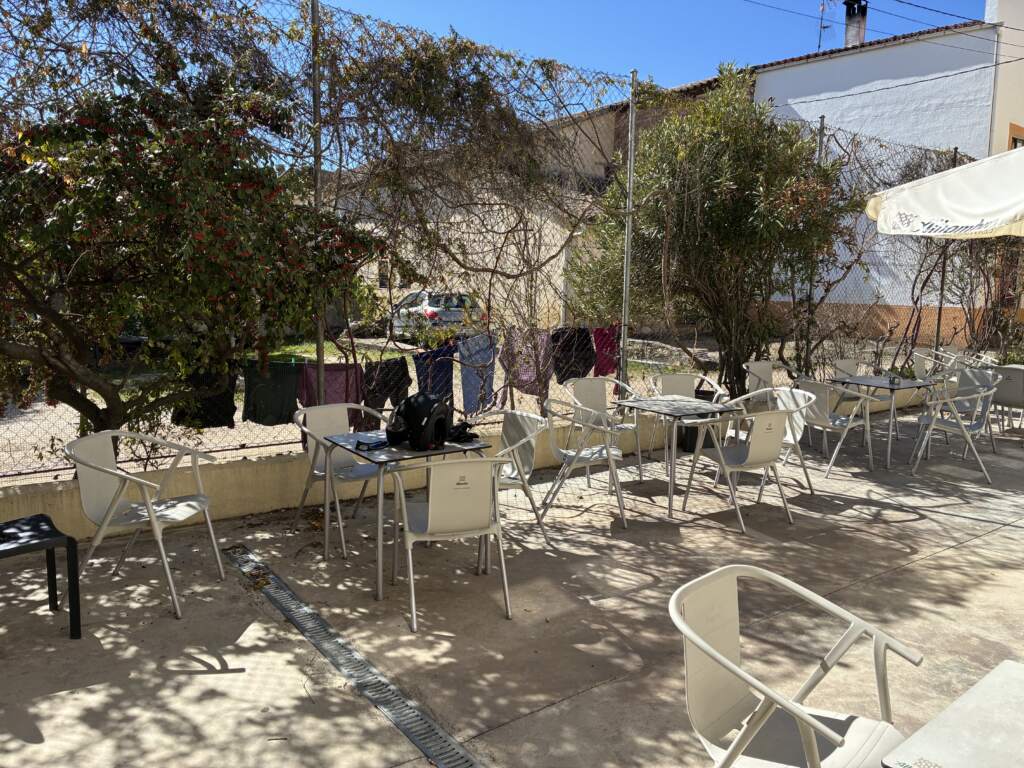
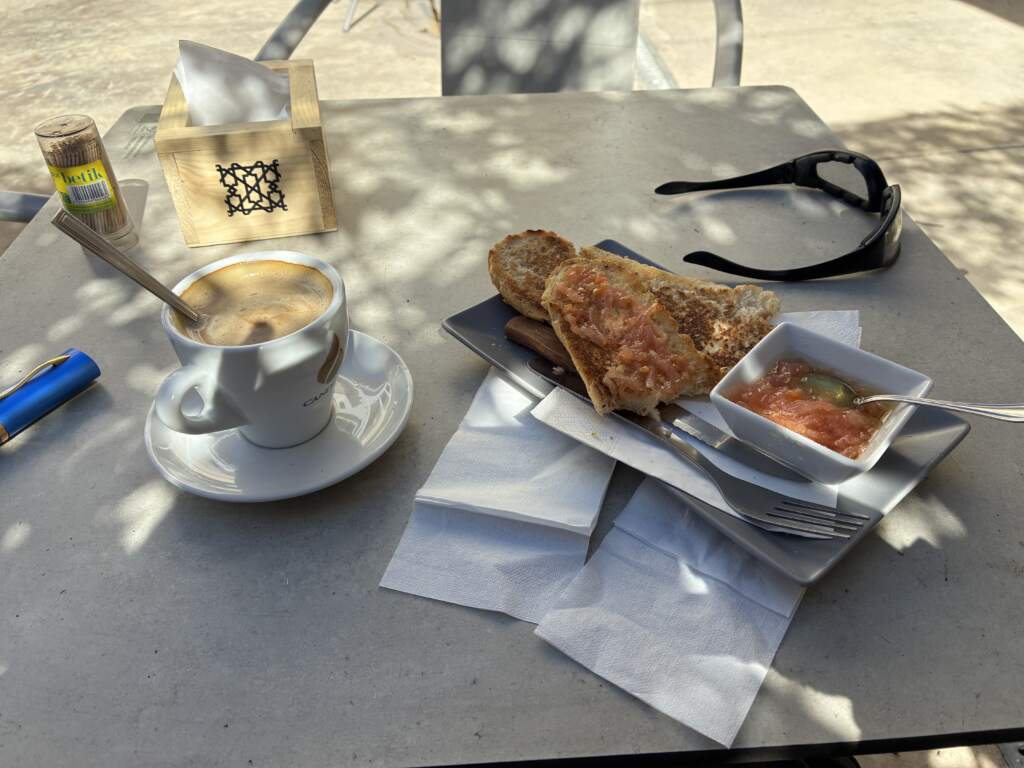
I sat on the terrace — three tables, not one more — and ordered my toast. Fifteen minutes later, breakfast arrived. The best I’d have in days. I don’t know the name of the village, or the bar, or the man. But I do know that toast with olive oil and tomato had something you won’t find in any place with a name on a map.
The road breathes
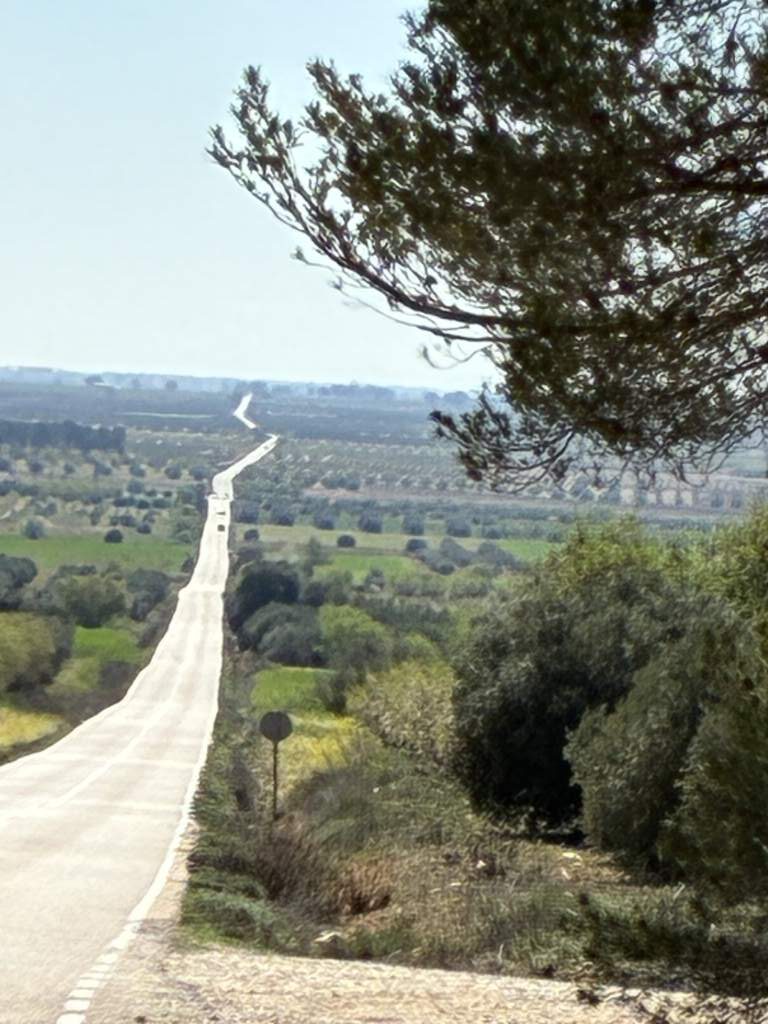
After breakfast, the bike and I picked our conversation back up. An open national road, in good shape, no trucks, just the odd car appearing and disappearing on the horizon. The kind of road that makes your shoulders drop without you even noticing. Total relaxation.
It had rained a lot here. You could tell from the deep green along the roadsides, between the trees, in the low-lying areas where the water hadn’t decided to leave yet. Sierra Morena had drunk up the whole winter and was still digesting it.
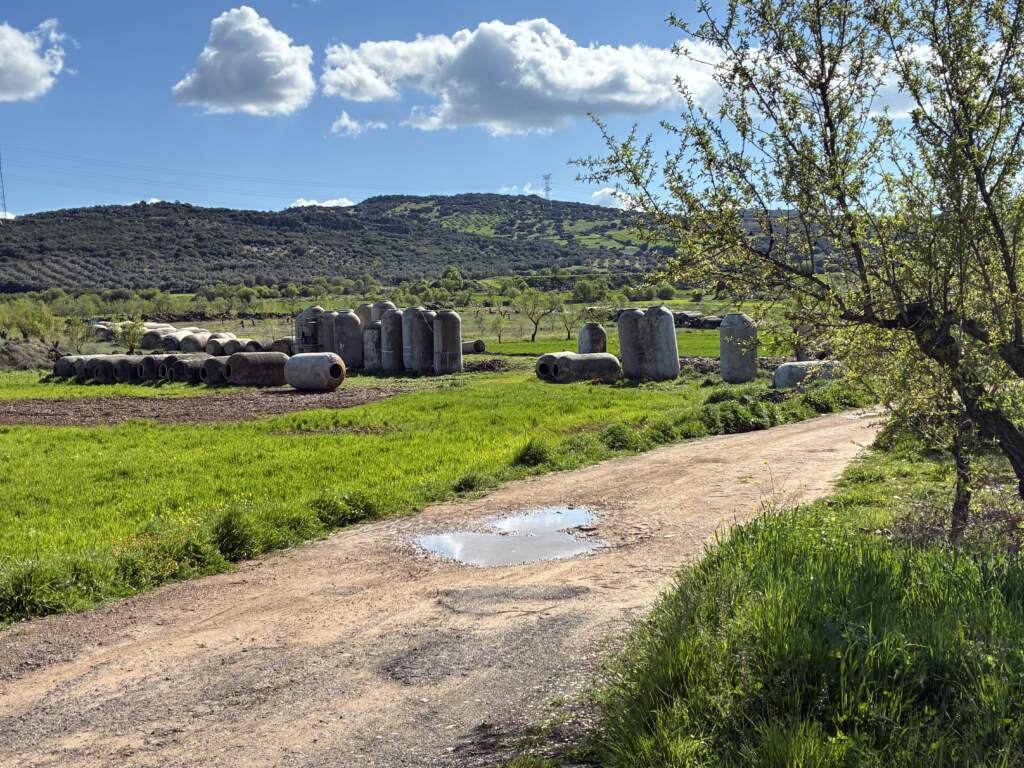
I kept stopping whenever something caught my eye — on routes like this, stopping is part of the plan. On one side of the road, stacked up for miles as if nobody quite knew what to do with them, huge concrete vessels appeared. Industrial jars, the kind once used to store wine. There they sat, abandoned, waiting for someone to give them a purpose. I kept seeing them for a long stretch, like a mystery that kept repeating itself.
In the afternoon I reached Villanueva de Córdoba and stayed at La Casa del Médico. One of those places that makes you understand why it’s worth digging around for different kinds of lodging, not just hotels. Tiles everywhere — on the walls, the floors, in every corner — and rooms that tell a story without saying a word. A place from another era. The kind that smells like another time and makes you feel like you’ve arrived somewhere, not just stopped to sleep.
The dehesa … stops you in your tracks
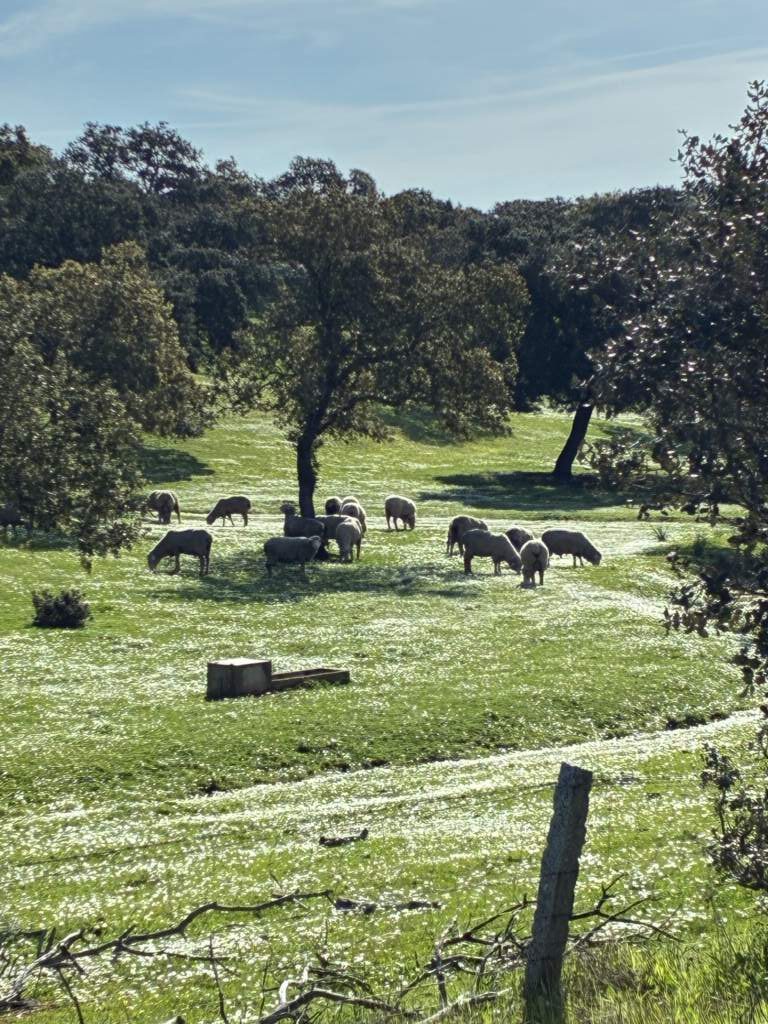
The next day, coming out of Obejo, the dehesa appeared (the definition in the link is worth a read). Cork oaks and holm oaks everywhere, with that calm, serious presence old trees have — the kind that have seen too much to be impressed by a motorcycle.
I stopped the engine.
And there it is — that moment that only happens when you switch everything off. The silence of the dehesa isn’t empty, it’s full. Full of birds you can’t see, wind moving through branches, sheep that don’t even bother looking up at you. Absolute stillness. No rush. Nothing to prove.
I stayed longer than I’d planned. The dehesa does that to you.
(The video says it all — though I’ll admit that on the GS 1300 it looks like I’m driving a tractor. That’s what these tracks do to you.)
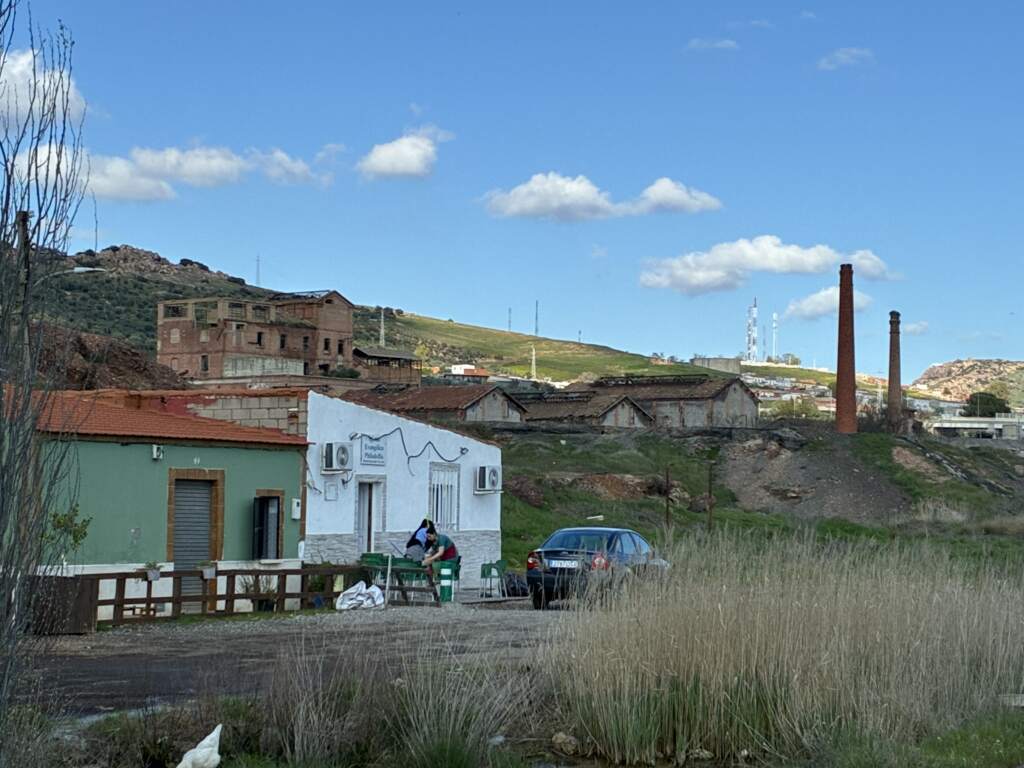
Ahead of me appeared the ruins of a mining and metallurgical complex, which I later read is listed as a site of cultural interest. I stopped to take a photo and get a closer look. I’m sure it had real influence on the region back in its day — but… cultural interest?
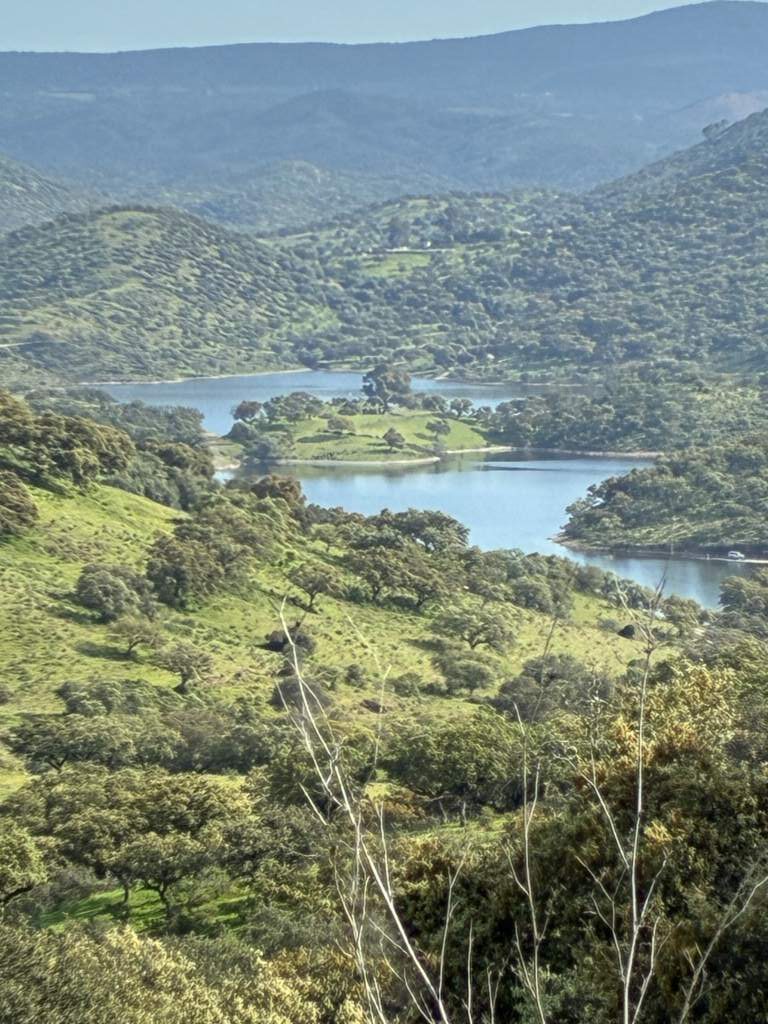
I passed near the Rumblar Reservoir and the road started changing character — tighter, more local, running alongside the holm oaks as it climbed. One of those old-school surfaces, narrow and solid, that seem indestructible because they’ve been just that for decades.
Cazalla de la Sierra: the restaurant that opens just for you
I spent the night in Cazalla de la Sierra. And that’s where I learned something important about Tuesdays in Sierra Morena.
When I got to the Airbnb, I asked where I could get dinner.
— Ah — the owner said, pulling a face — today being Tuesday, it’s going to be tricky. Seven of our eight restaurants are closed. Only the pizzeria’s open.
— But… how do they all close on Tuesdays?
— I know, right. But around here it’s always like that — she paused and raised an eyebrow with that look that says what’s the harm in trying? — Though if you call the restaurant Agustina, they might just open up for you.
I called. Booked a table for 8:30. And went. Incredible.
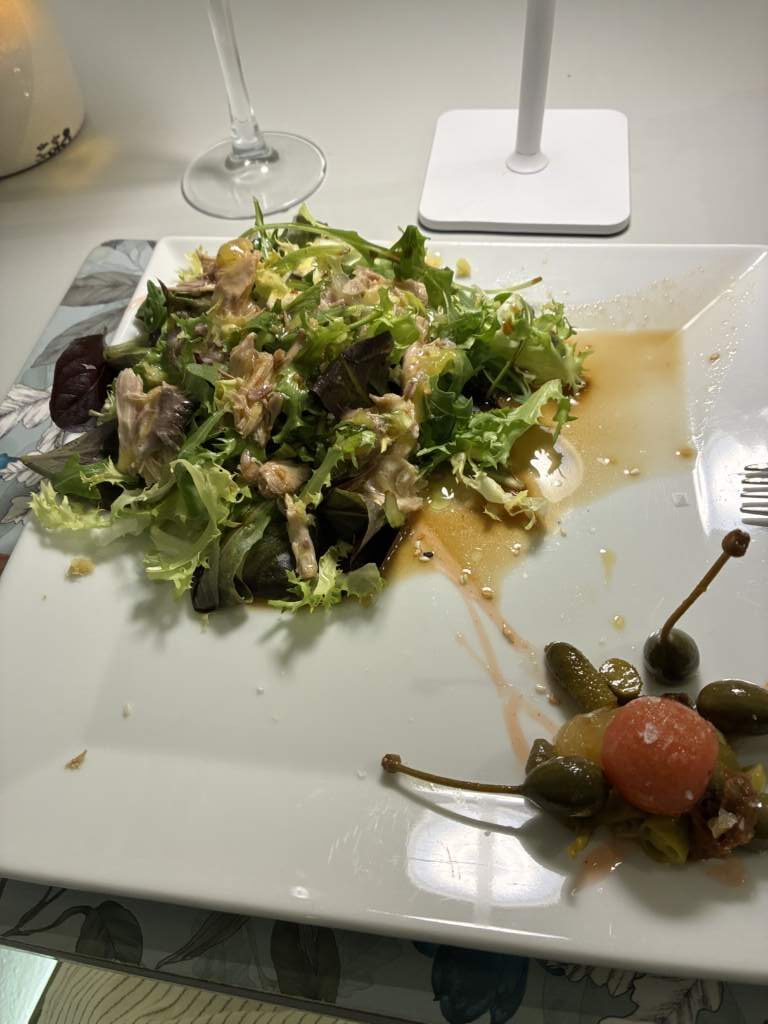
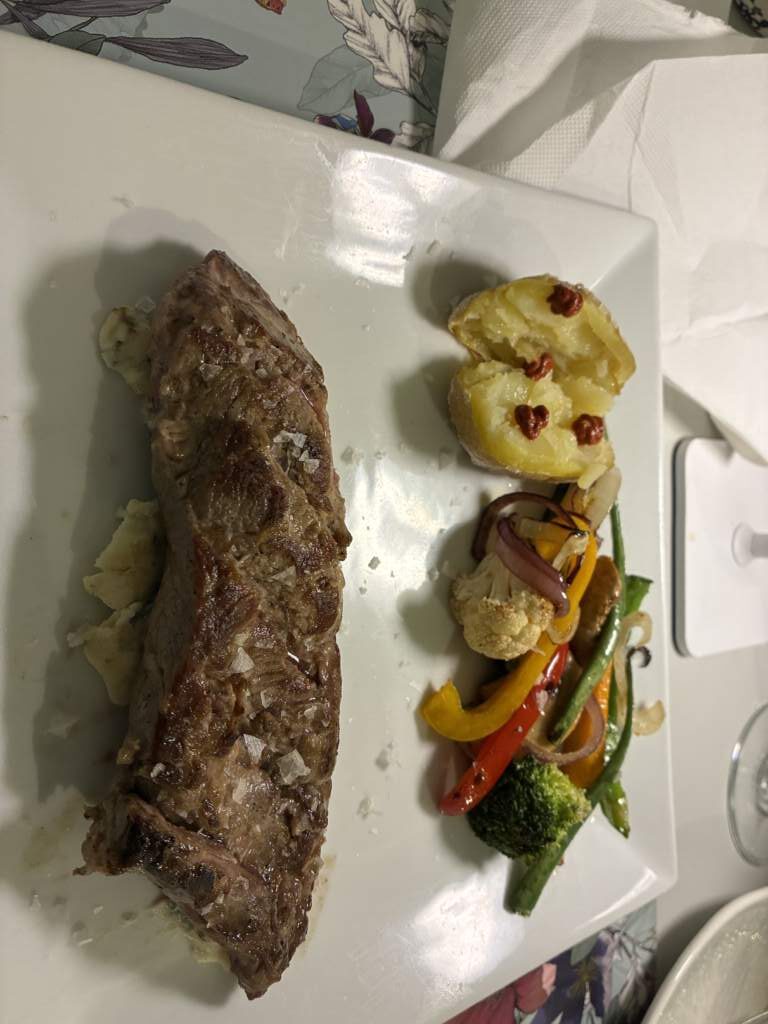
I was the only one in the restaurant that night. The owner cooked just for me, and between courses we had one of those conversations you don’t go looking for but that show up anyway. I let him guide me on everything — that’s what people who know are for. What he suggested, I ordered. What I ordered, he cooked. What he cooked, I ate. The wine he poured, I drank — made 100 meters from the restaurant. Nothing more needs saying.
The wrecked road — or how to slalom without skis
The next day, after Obejo and its holm oak groves, came the stretch I won’t forget for a long time.
The C-433 road was decommissioned when the new A-8101 opened. But it’s still there. Forgotten, broken, left to its fate — and precisely because of that, perfect.
I dropped into second. Stood up on the pegs. Thirty, forty kilometers an hour. And I started smelling it — that smell of old asphalt, damp earth, a road that’s in no hurry because nobody’s cared about it for a long time.
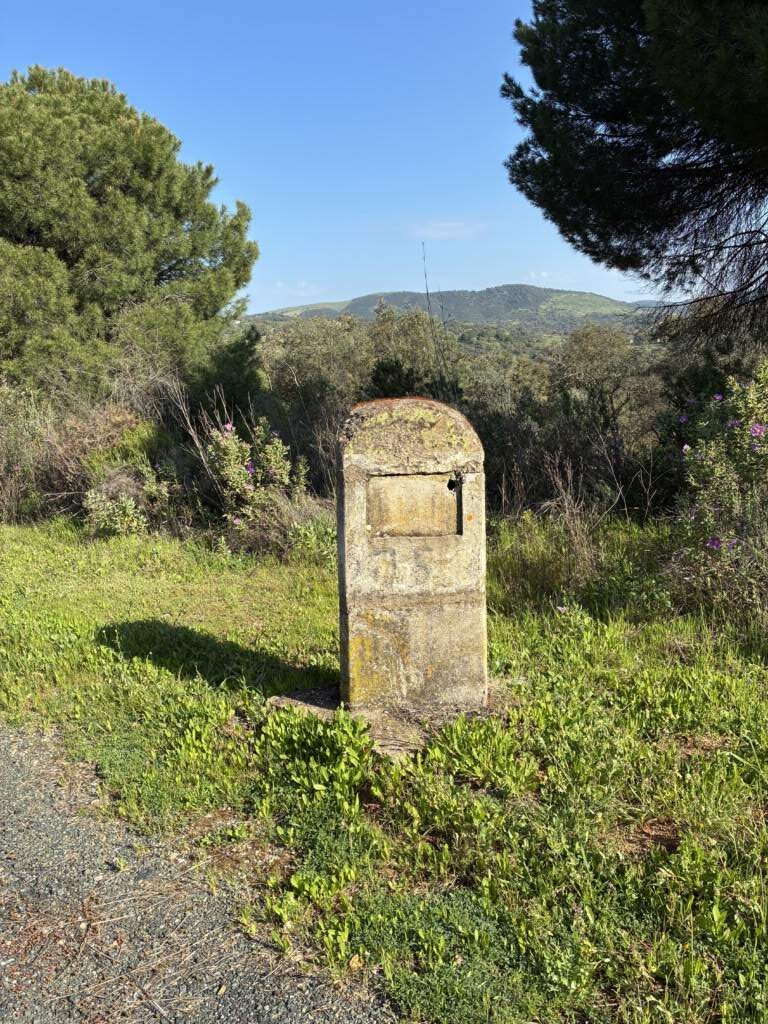
The milestone said it all. Battered by wind and rain, leaning slightly, having lost its battle against time — but still standing, marking that this road once connected El Pedroso with Cazalla de la Sierra. A survivor.
It was like running a slalom course. The potholes weren’t potholes — they were craters, deep pits. The cracks were trenches. The bike and I kept picking the right line, fully focused, not thinking about the scenery or where we were headed. On stretches like this, the road swallows you whole. There’s no world beyond the meter in front of you.
Better to stop every now and then. Breathe. Look around. And keep going.
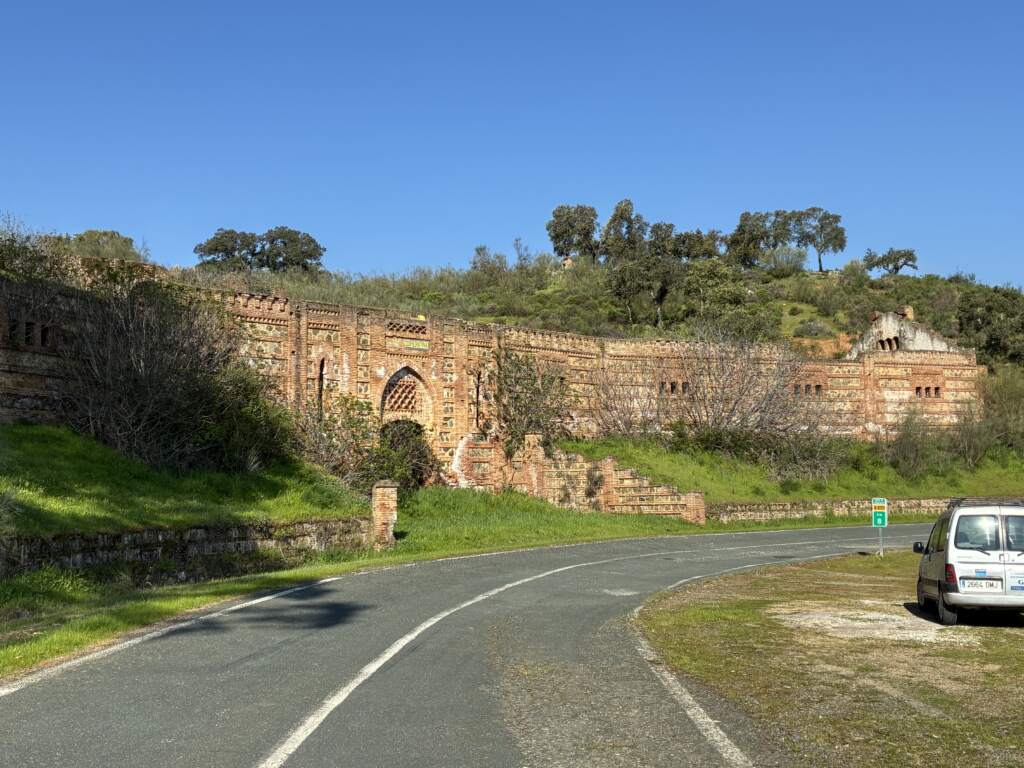
And then, coming around a right-hand bend, it appeared. At kilometer 8, the façade of what used to be the Cooperativa Colonias de Galeón. A large building, imposing even in its current state, that was once the heart of a massive project — a great estate turned into wine and a way of life, dreamed up by Spain’s Junta Central de Colonización. Now only the façade remains.
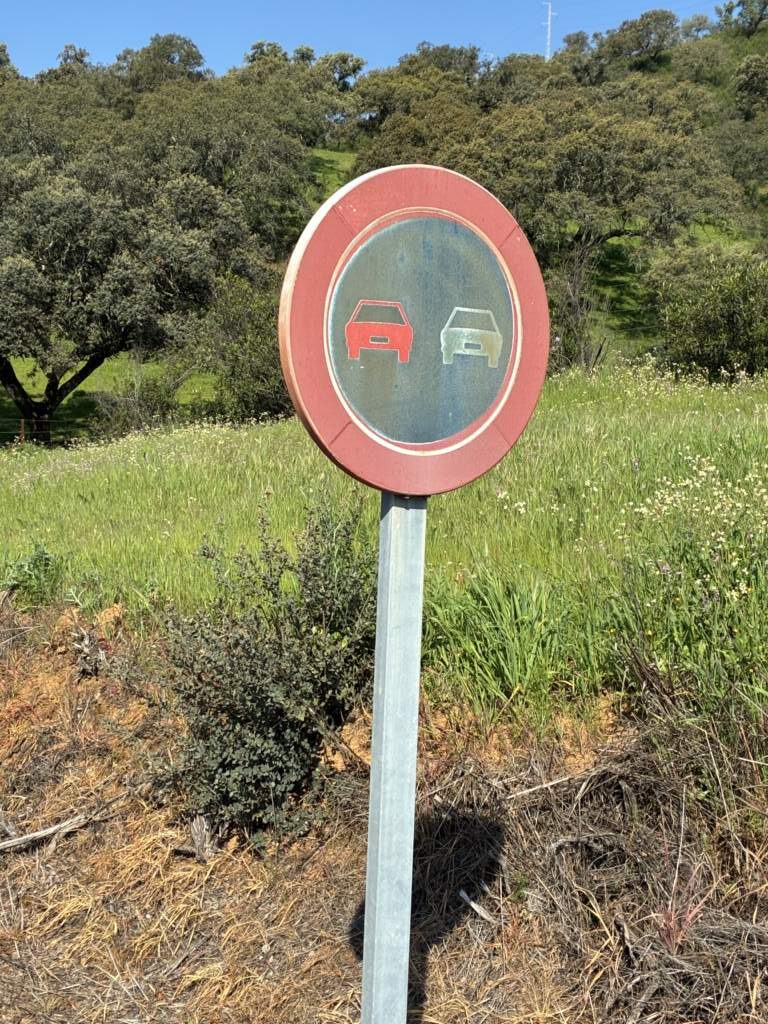
I kept riding, not knowing where the road would lead. But nobody passed by — no cars, no bikes, and definitely no motorcycles. Nobody. Which, thinking about it, had its upside: at least there was no one to overtake.
El Pantano del Pintado — and time standing still
And suddenly, the reservoir.
The El Pintado Reservoir appeared out of nowhere, full to the brim. Opened in 1947 and preserved exactly as it was back then — on the outside, at least. Like someone had stopped the clock and nobody had ever wound it back up.
Seeing that much water, here in Sierra Morena, puts you in a genuinely great mood. I can’t explain it any better than that.
The road started improving past the reservoir — as if whoever comes to maintain it arrives from Cazalla rather than El Pedroso, fixing their own stretch along the way but not the other side. Unconfirmed theory, but it explains a lot.
I could finally shift into third every now and then. A noticeable improvement.
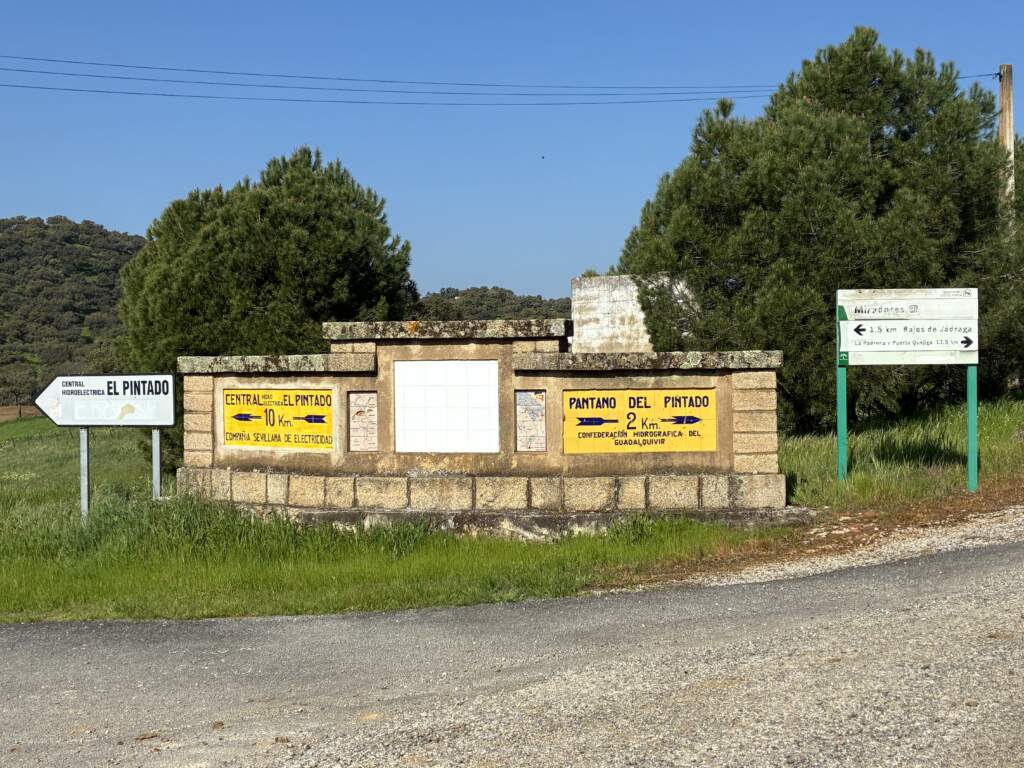
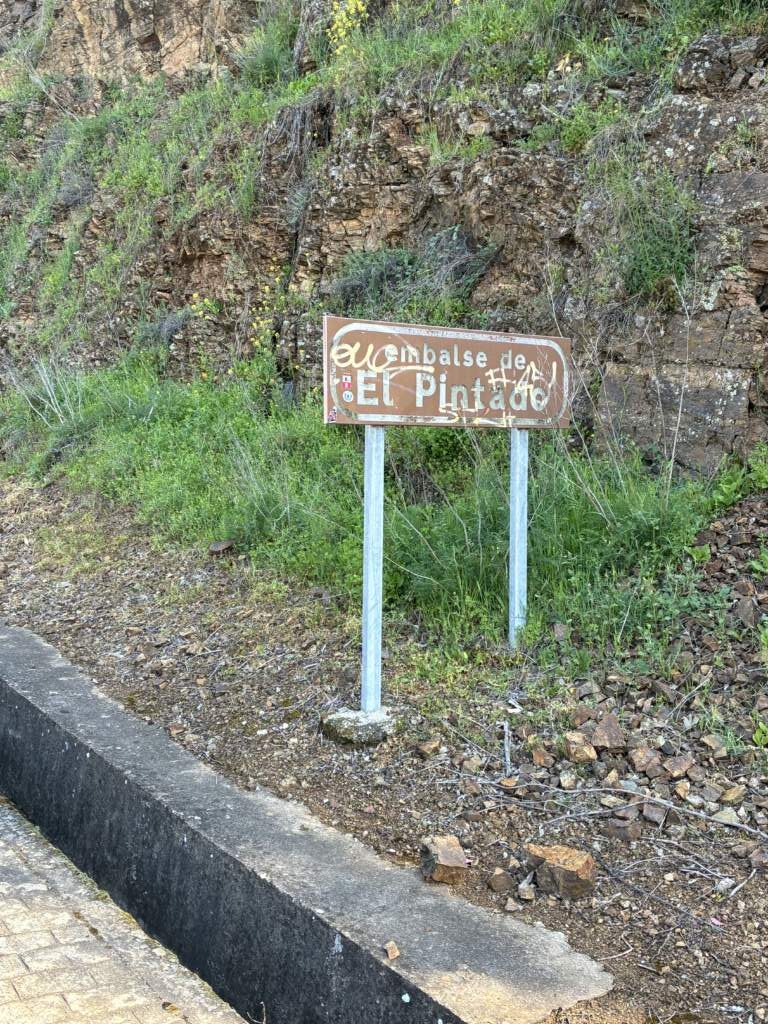
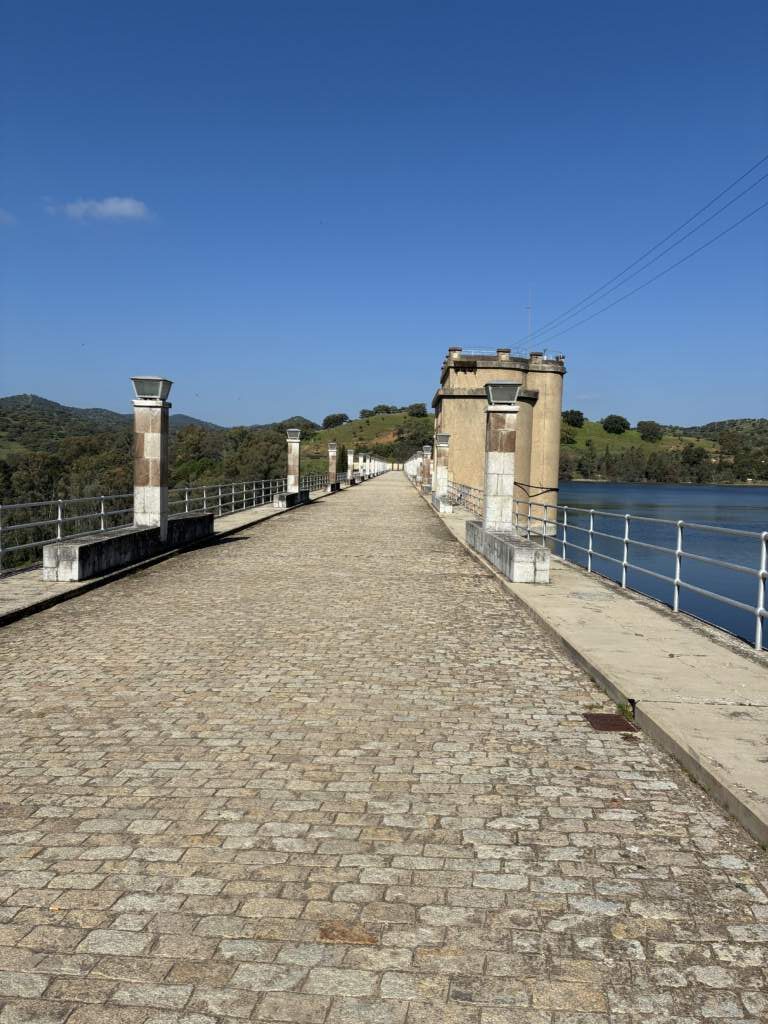
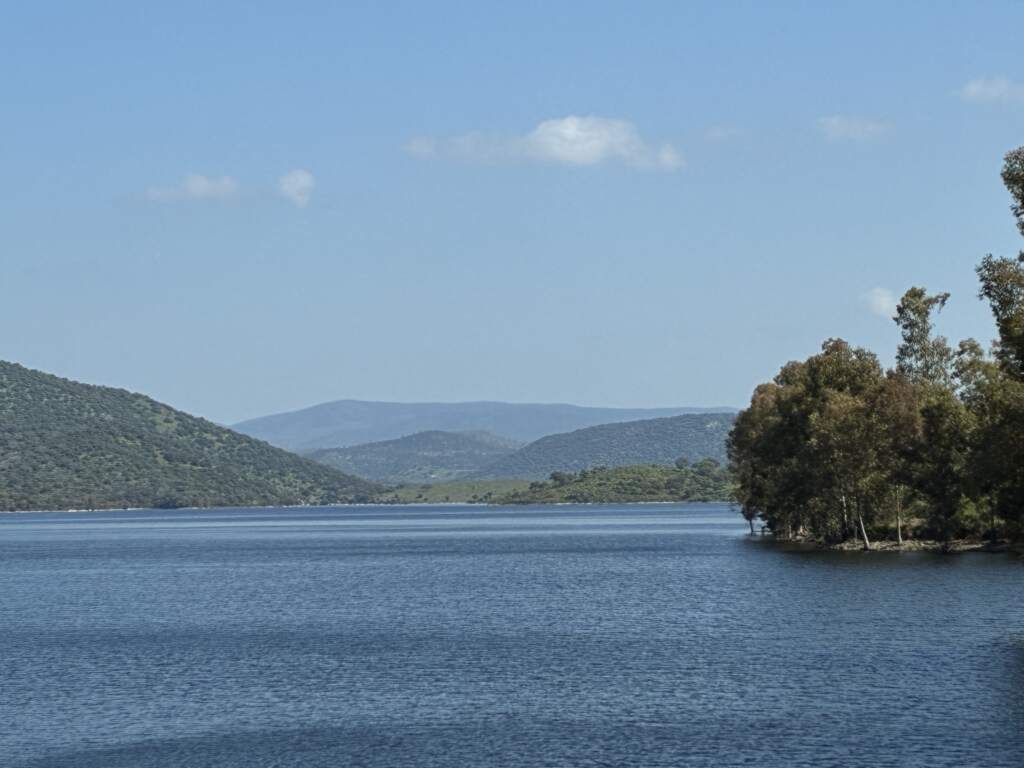
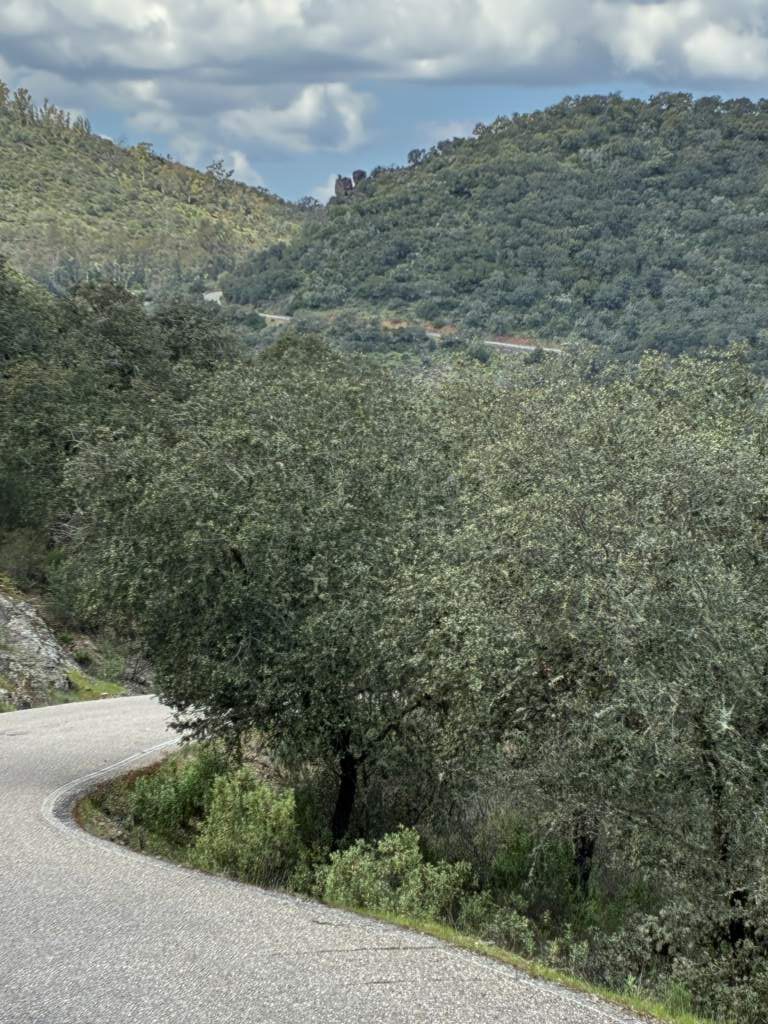
And the trees just stood there, on either side, completely ignoring me. They mind their own business. They’ve been talking among themselves for centuries and don’t need a rider as a witness. Between them, the road wound its way up. Perfect for third and fourth gear, letting yourself go with it.
The tomato drama
I reached a bigger village and decided it was time for second breakfast — yes, second, because the first one felt like a long time ago.
A lovely woman served me, with a wide smile.
— What can I get for you?
— I’d like toast for breakfast, please.
— Of course. With olive oil, right?
— Exactly. The good stuff.
— And tomato? — she asked, raising an eyebrow.
— Yes, that’s it. Tomato and oil.
Then her face changed. She showed me the plastic container with the grated tomato. Inside was an amount that, being generous, would cover about half a slice of toast.
— Well, we have a problem — she said, frowning. — That lady got here before you, and there’s only enough left for her.
I looked at it. I looked at her. I looked at the container.
— Could you maybe make a little more for my toast?
— Ah, that won’t be possible. I make one tube of tomato a day, and once it’s gone, that’s it for tomato toast.
— Are you seriously telling me I can’t have tomato with my breakfast?
— Yes, that’s exactly what I’m telling you. You’ll have to come a bit earlier next time.
I stood there looking at her for a few seconds. She looked right back, calm, without a shred of doubt. The tube of tomato was the tube of tomato, and there was no negotiating that.
I left, waving goodbye and wishing her a good day. No breakfast. The next village felt far away — not in kilometers, but in time. Which sometimes is the same thing, and sometimes isn’t.
After that I carried on to the Rio Tinto mines, where I won’t share my impressions here since there are already plenty of long videos out there about them. It’s also not really a motorcycling topic. I’m always struck by, and love, open-pit mines — and underground coal mines too.
The finish line: Almonaster La Real
After the Rio Tinto mines — which, as I said, deserve their own chapter and don’t fit here — I reached Almonaster La Real. The end of the Sierra Morena route.
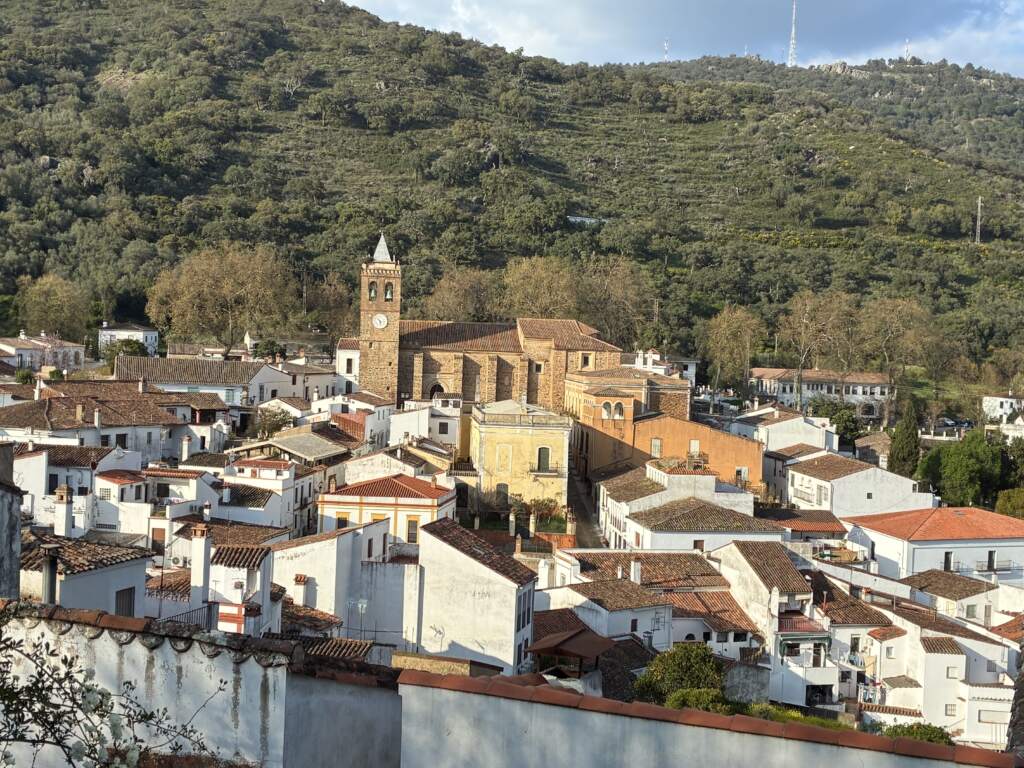
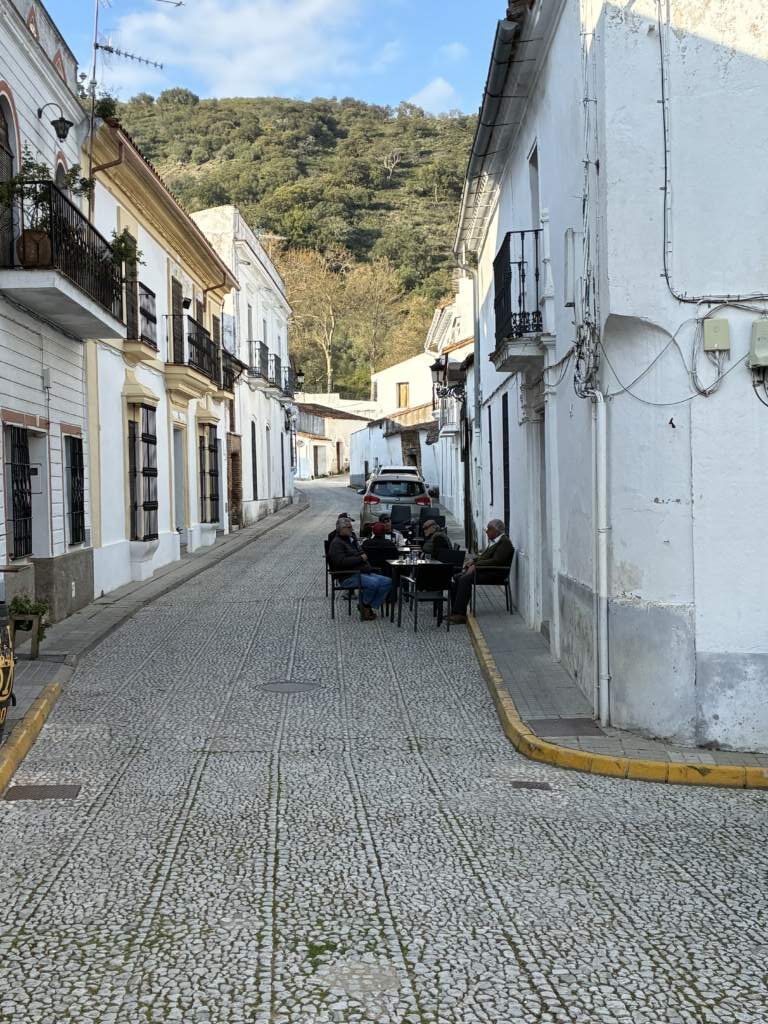
I parked the bike, took off my helmet, and just stood there looking at the village. People with chairs out on the street, in the shade, deep in conversation. Streets that tell you how people live without needing a single sign. The old wall wrapping around the village like an embrace.
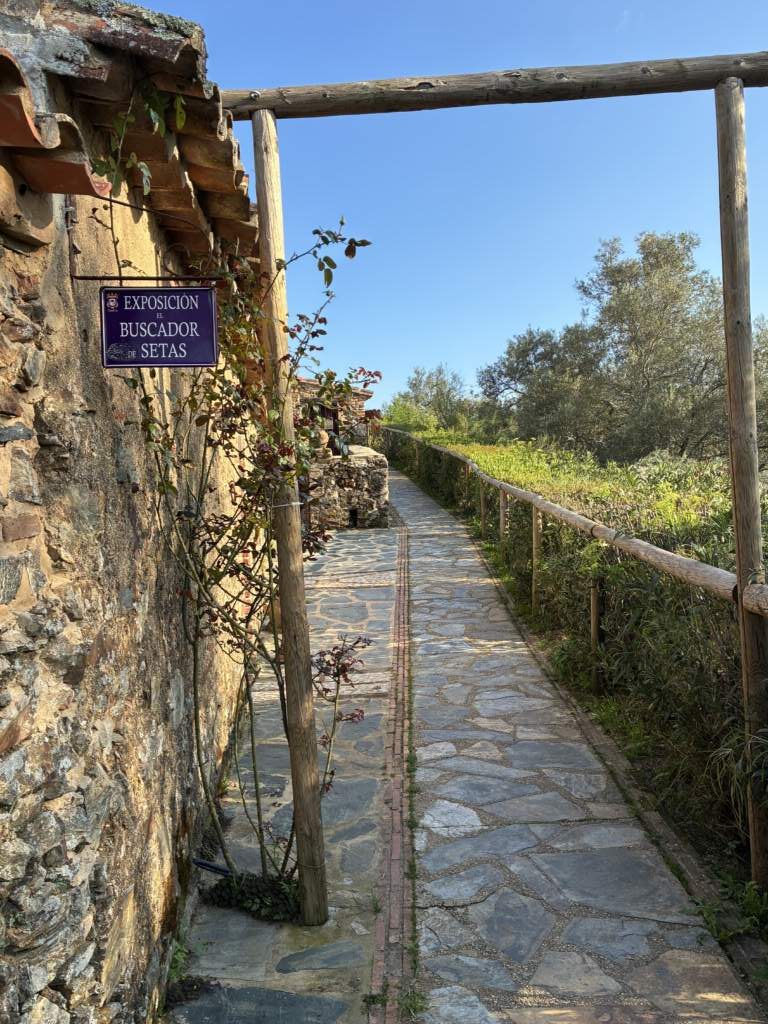
Sierra Morena is one of those routes every rider should do at least once. Not because it’s the most spectacular, or the most technical, or the most famous. But because it has something that can’t quite be explained — and if you don’t ride it yourself, no one will ever be able to tell you what it is.
And that, in the end, is exactly what we’re all looking for.