March 21, 2026
The Maestrazgo motorcycle route. Even the name sounds like something left outside of time. And it’s no coincidence: these lands belonged to the Knights Templar back in the 13th century, with Cantavieja and Mirambel as their centers of power. Templars, castles, medieval secrets … and me, with the bike parked in the garage.
Here you can find a bit more on the topic.
You’ll find the route I followed on the map below, including the 63 kilometers that make up the so-called Silent Route, and I promise the name isn’t marketing; one Saturday in March and I came across more crows than cars.
I set off with that mix of laziness and eagerness you only understand when you’ve got a bike waiting for you downstairs. Fourteen degrees, just enough sun to not complain, and the A-1401 ahead promising curves.
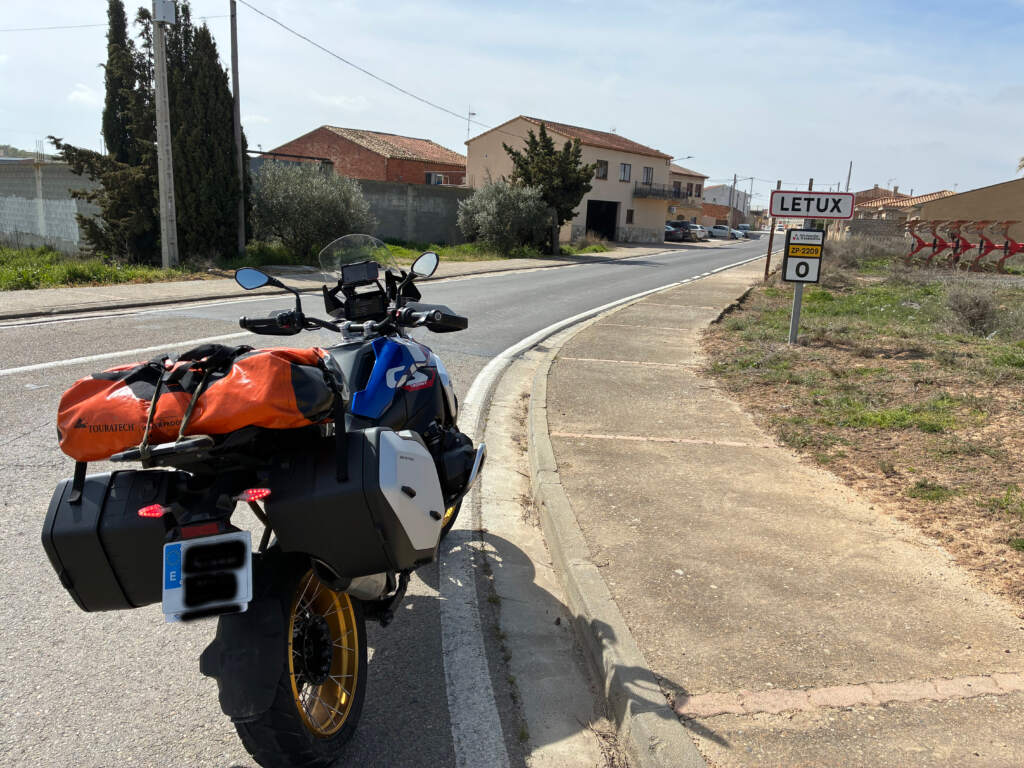
I passed through Letux, the village of a friend of mine. Took the obligatory photo next to the sign — the kind of photo that serves exactly one purpose … sending it on WhatsApp with a “look where I am” — and carried on. Miles later, when I was already around Albalate del Arzobispo, with the sun warming up my helmet, he called me. Said he was in the village. Asked why I didn’t come back. Said we could grab something. A real shame, I hadn’t expected it, but I couldn’t turn back — I had to keep going.
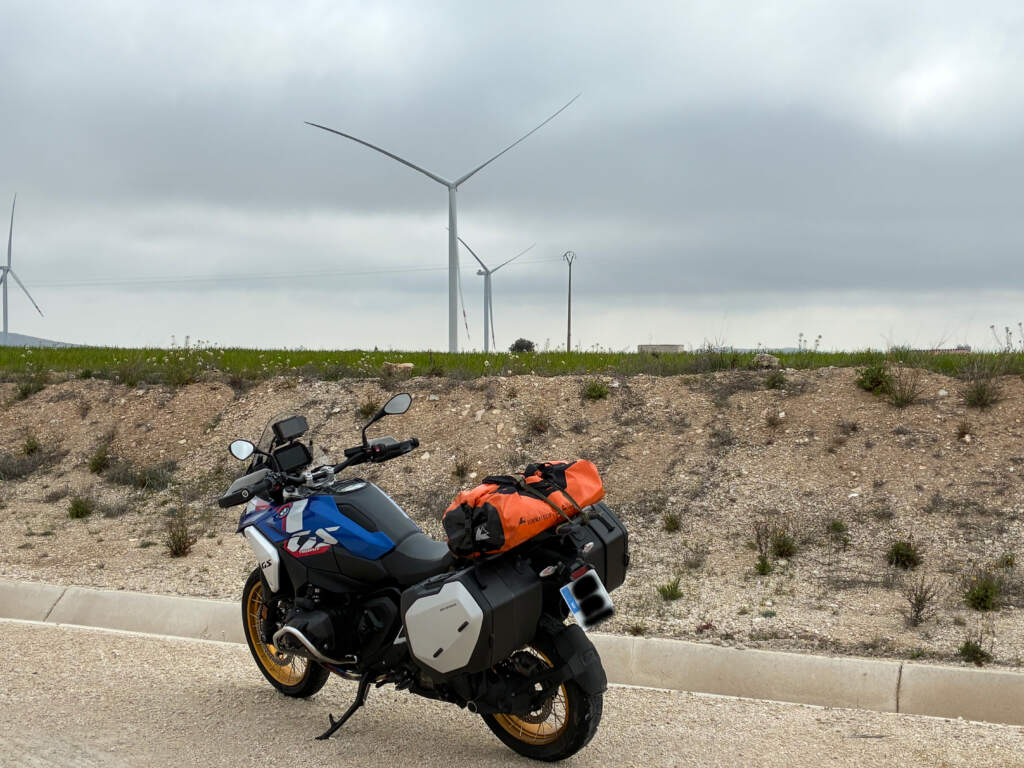
Before reaching the Maestrazgo proper, the road treats you to a sight you don’t ask for but appreciate anyway: wind turbines. Not Don Quixote’s — those are the friendly white kind. These are something else. Steel giants with blades brushing 85 meters. That day they stood still, silent, as if they too were part of the Route. Majestic, if a little intimidating. I watched them for a moment from the bike, engine still running, which is the biker way of saying something impresses you … but not enough to take the helmet off.
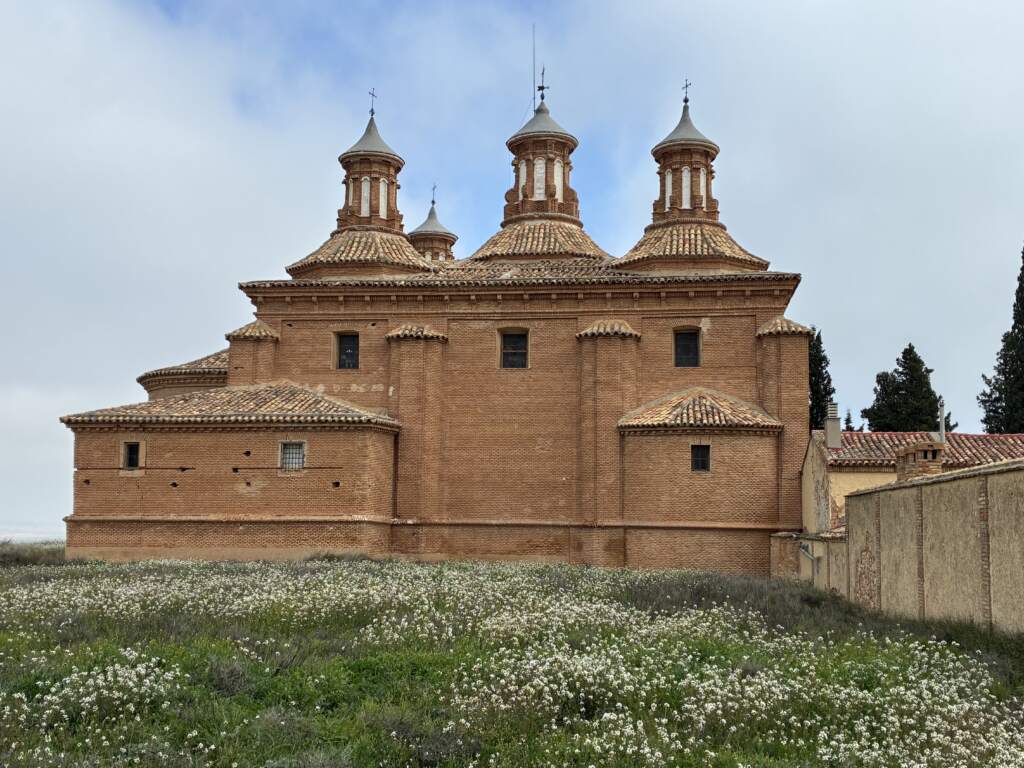
A little further on came the Sanctuary of Nuestra Señora del Pueyo. I rode up. It was closed. It has that Baroque-meets-Mudéjar architecture that makes you sorry you can’t go in. The day before, riding up to the Sanctuary of Nuestra Señora del Moncayo, I saw a sign that summed up, with brutal honesty, the state of rural heritage: “They’ve already robbed it. There’s nothing left to take.” Sounds like a joke. It isn’t.
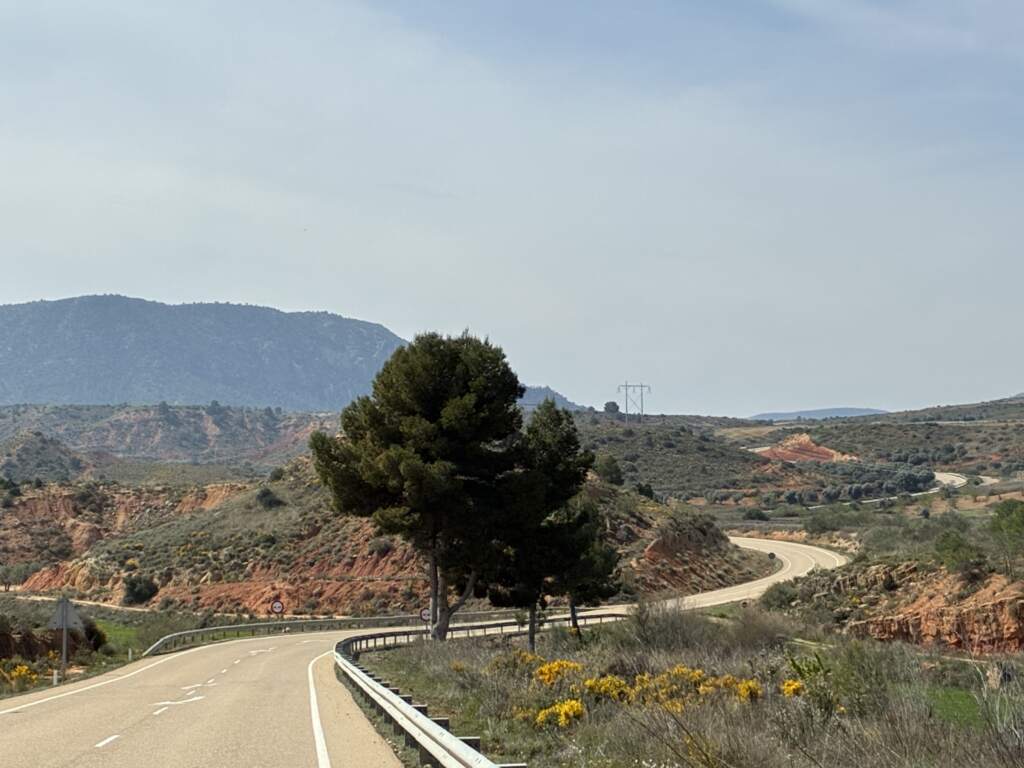
The A-1401 and A-1402 heading toward Alloza are the kind of roads that never make any “best motorcycle routes” list, and they should. Perfect asphalt, curves with real intent, scenery that changes every couple of minutes and, most importantly, nobody around. Just you, the engine, and the holm oaks. At fourteen degrees with the sun on your face, that’s more than enough.
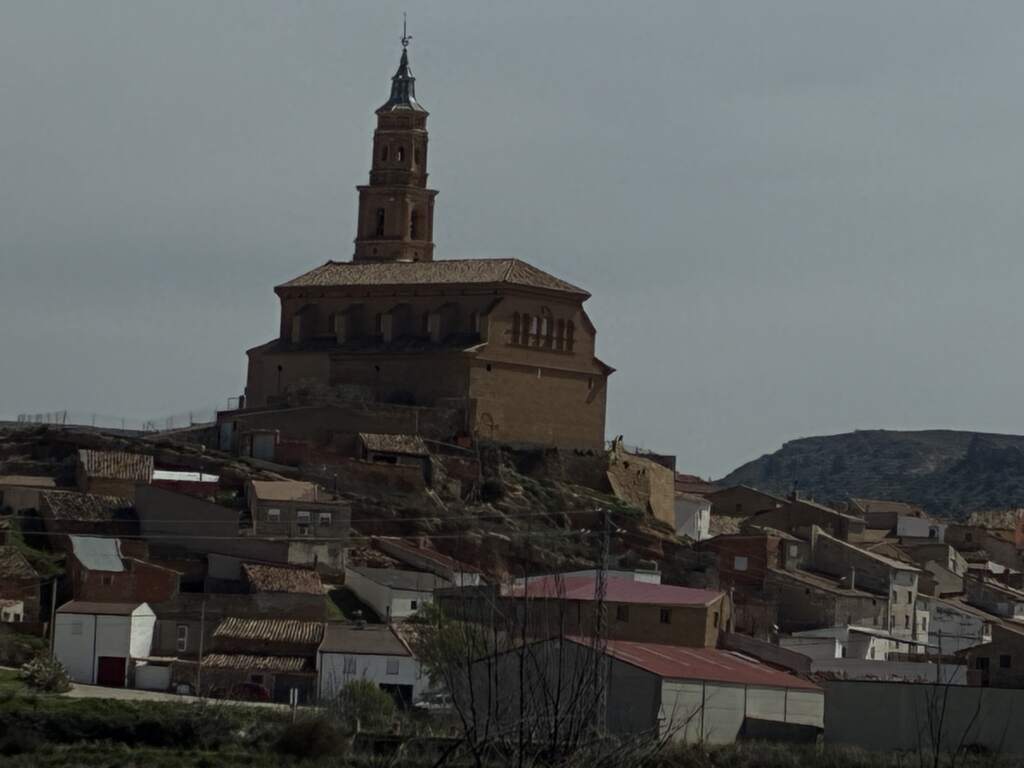
In Alloza you can’t ignore the Church of La Purísima Concepción. Not because any guidebook tells you to, but because it stands right there in the middle of the village staring you down, as if to say “stop, photograph me.” I stopped. Photographed it. Rode on.
It was a bit further along, still on the route, that I saw the first sign for the Silent Route, this time in English, going through the Loma del Ejulve pass. Unfortunately I didn’t spot any campervans or foreign license plates, but the signs are there, waiting for when they do pass through.
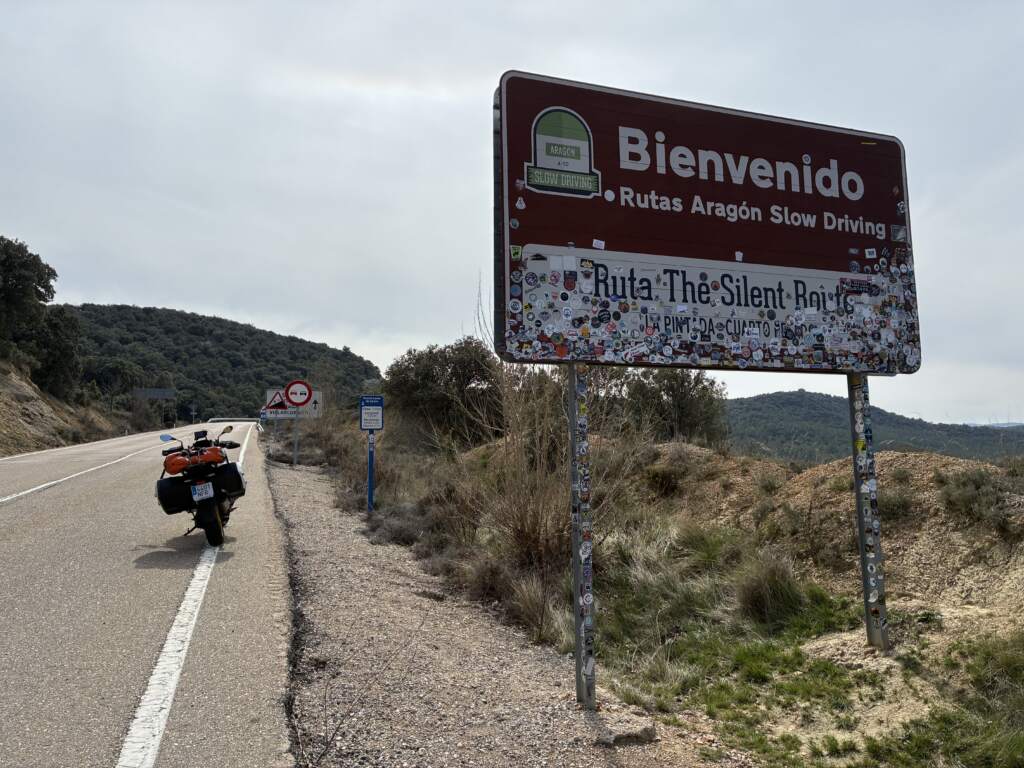
Then came one of the highlights of the day — the Cuarto Pelado Pass and its viewpoint. This spot has quite a reputation among riders, and once you get there, you understand why.
The goat is the emblem of the Silent Route, representing the essence, wildlife, and untamed spirit of the Maestrazgo mountains.
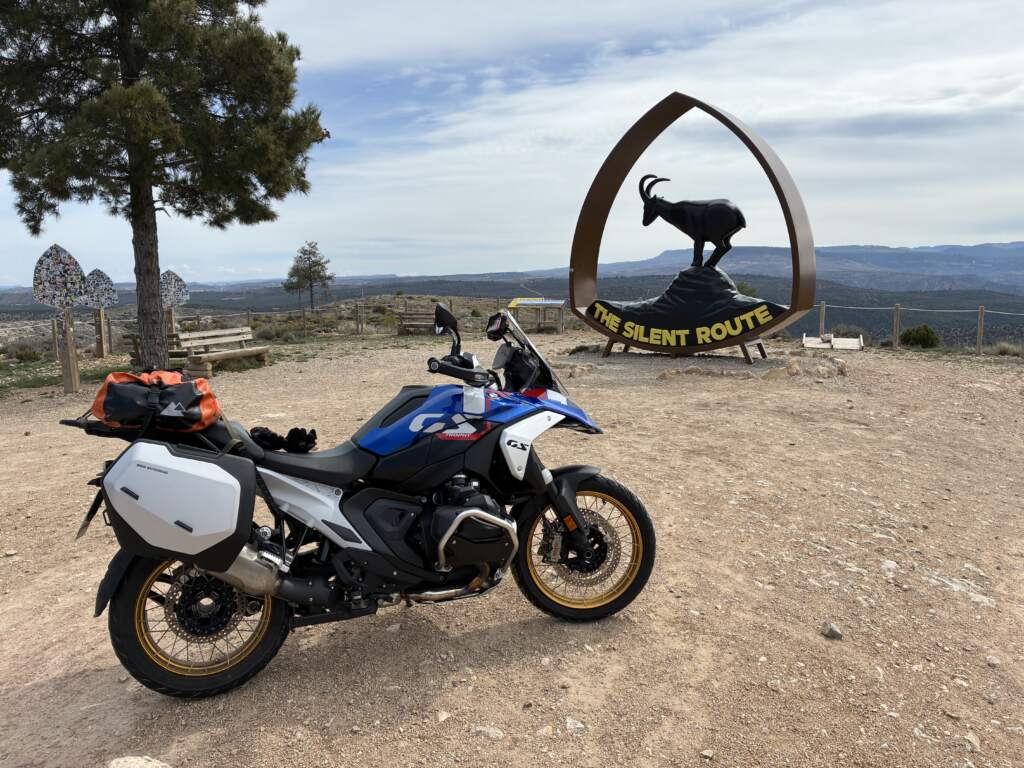
Let me tell you about the great debate that splits the motorcycling community into two irreconcilable camps.
Team pro-sticker — you have to leave your sticker on the pass sign. It’s tradition. It’s identity. It’s leaving your mark.
Team anti-sticker — it’s vandalism, plain and simple. Ruins the landscape. We’re better than that.
Here, someone found the perfect diplomatic solution. Boards set up specifically for stickers, leaving the goat with its dignity fully intact. Everyone happy.
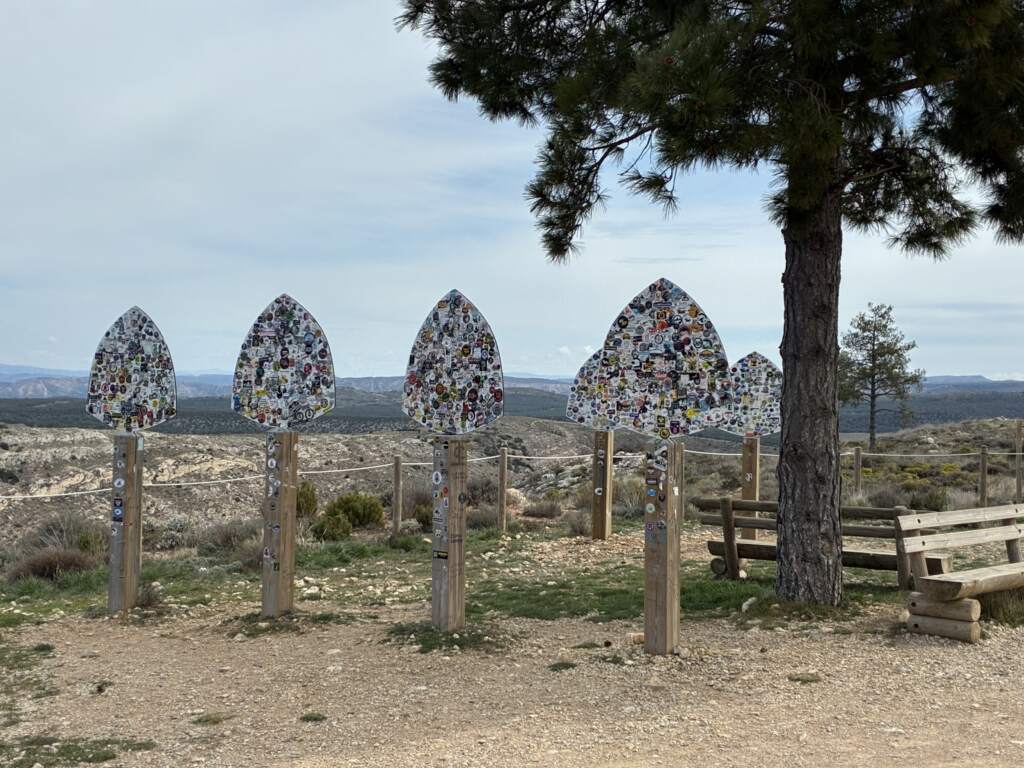
There wasn’t a single motorcycle when I arrived. None when I left either. The Maestrazgo’s absolute solitude, in its purest form.
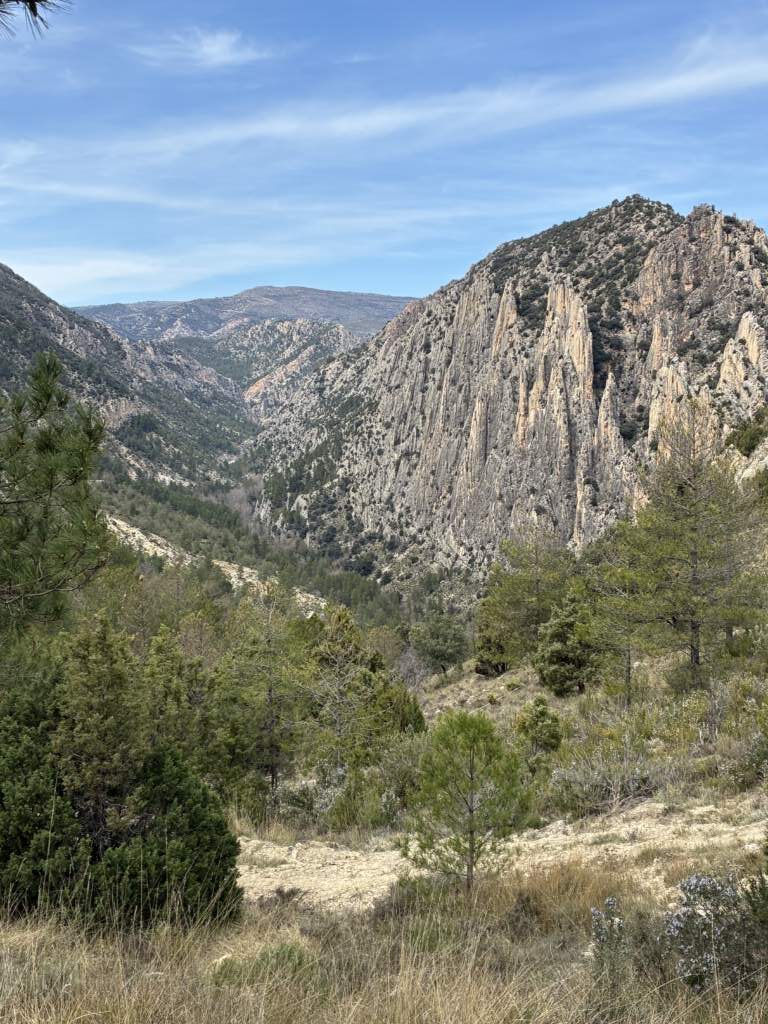
The Órganos de Montoro rock formations deserve you killing the engine, getting off the bike, and taking off your helmet to just stand still for a few minutes. They’re vertical rock formations that look like they belong on another planet, or in a low-budget sci-fi film with great ideas. I read the info panel. They struck me as one of a kind.
Then came Tronchón, and it came by accident, which is how the best places always show up.
I saw the turnoff. 18 kilometers to the village. I pictured it as a dirt-track kind of road, full of potholes and deep pits, with goats wandering across it. What I found instead was 14 kilometers of flawless asphalt, with climbs, drops, and curves that make you downshift not because you need to, but so they’ll last a little longer. The final 4 kilometers were indeed what I’d expected. But by then I could already see the village on the horizon, and it didn’t matter.
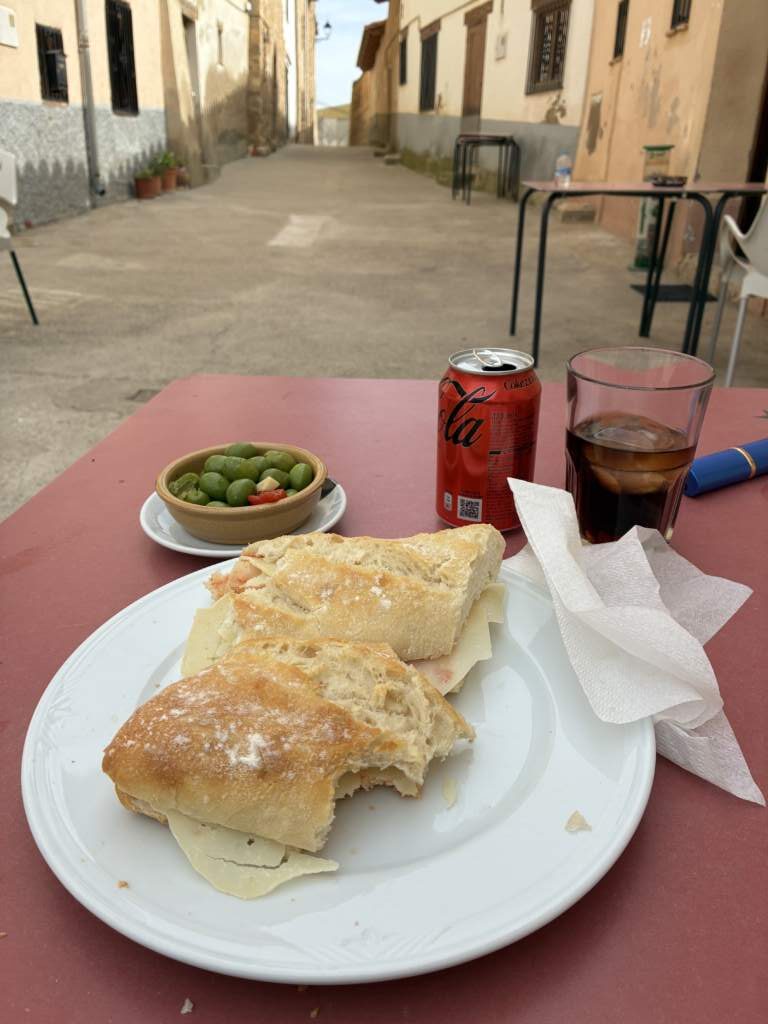
Tronchón has one tavern. Just one. And it’s enough.
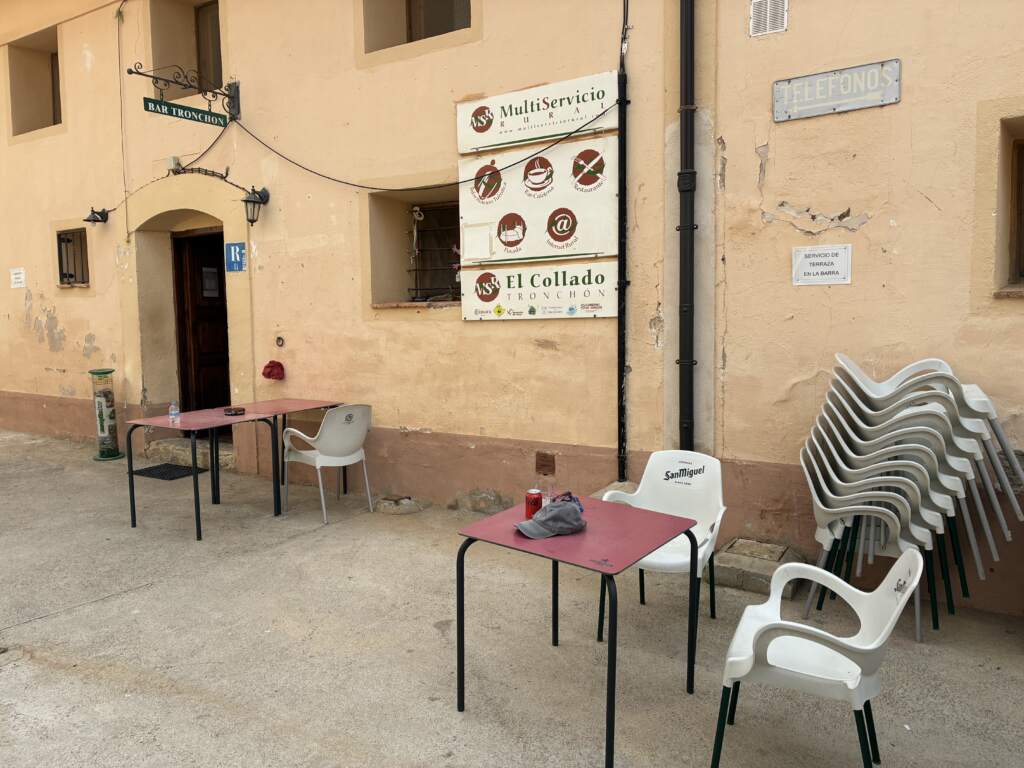
I ordered the cheese everyone talks about, and they also brought some local green olives I hadn’t expected. They were the best thing all day. I took my plate outside to the terrace, or street really, since the weather was good, and it wasn’t long before two guys from a group of riders eating inside came out. Eight or ten of them, all on BMWs, all staring at the 1300 GS like it was some strange animal.
“Is that the semi-automatic?” “Yes.” “How does it handle?” “Really well. Though every now and then I miss the clutch.”
A lie. I don’t miss it one bit.
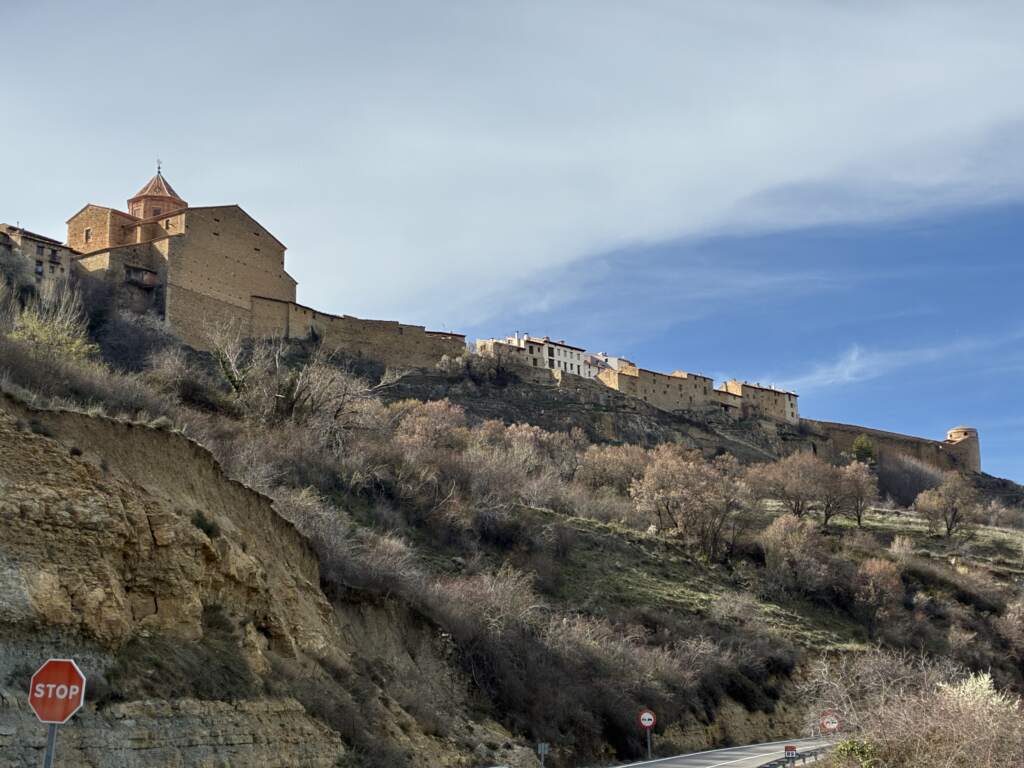
Leaving Tronchón, the A-226 takes you toward Mirambel and Cantavieja. I didn’t go into either — time was running short and Teruel was waiting — but Cantavieja doesn’t need you to go in: it’s literally perched on the mountainside, and seeing it from the road, still on the bike, is already a spectacle. One of those villages that seem to defy gravity and the 21st century at the same time.
I left the Pitarque Tunnels Route for another day. The detour to Tronchón ate up my time and I had to choose. I’ll do it next time. Because I’ll be back.
The Maestrazgo is one of those places that never quite lets you go. You leave feeling like you’ve seen a lot, and that there’s still more. That there are villages at the end of routes you didn’t take, viewpoints you never found, bars with a single table where there’s surely someone with a good story to tell.
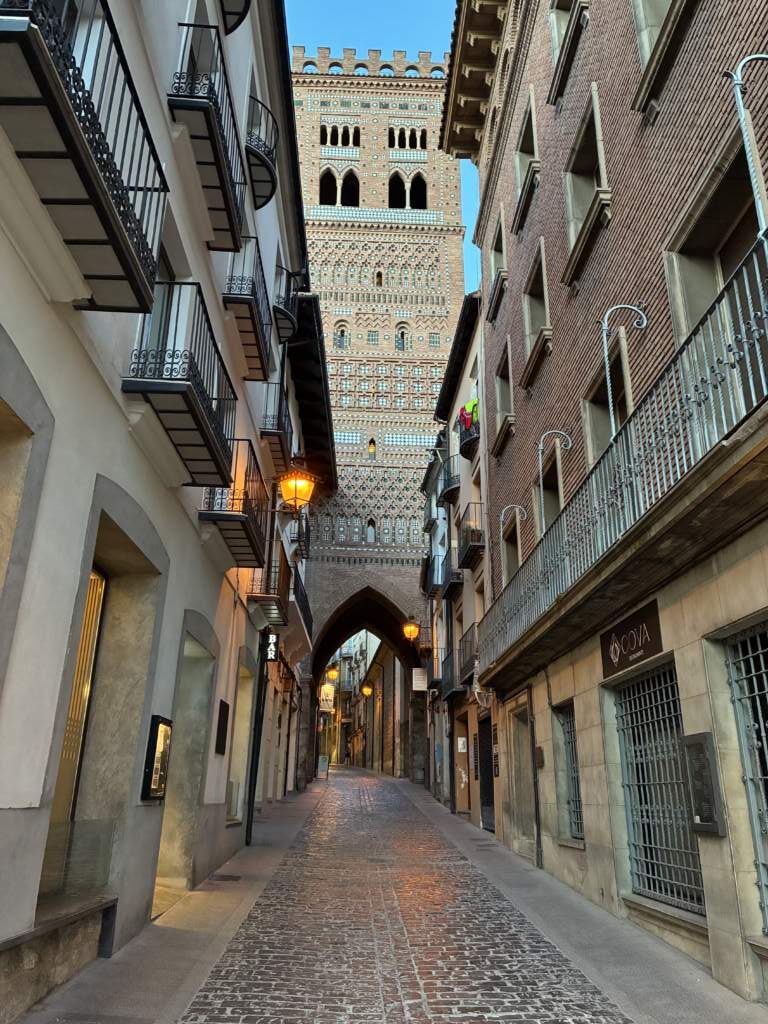
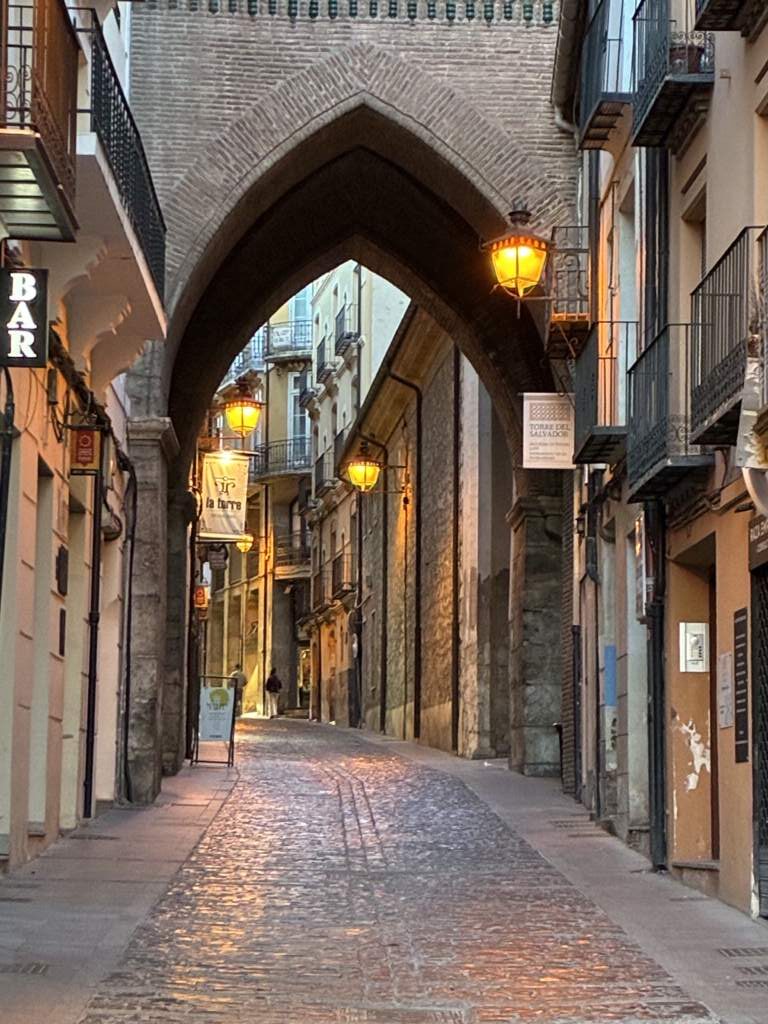
Before wrapping up this post, I want to leave a few photos of the Torre del Salvador in Teruel (worth a read for anyone who loves Mudéjar architecture). Pure Mudéjar. The kind of thing that makes you think the 14th century, for some things at least, had us beat by a mile.