
With Yosemite now behind us, it was time to start the Crater Lake motorcycle trip back home. And this leg of the trip, far from being a simple return journey, gave us some of the most striking scenery of the entire route — with Crater Lake National Park as the standout — and a final day nobody saw coming.
Lake Tahoe: A Vastness That Doesn’t Even Crack the Top 10
The day after our rest day, we headed north toward Susanville, a small town where we’d spend the night in a cabin. Along the way, we crossed Lake Tahoe — a body of water so massive that, the moment we saw it, we started wondering whether it was the largest lake in the United States.
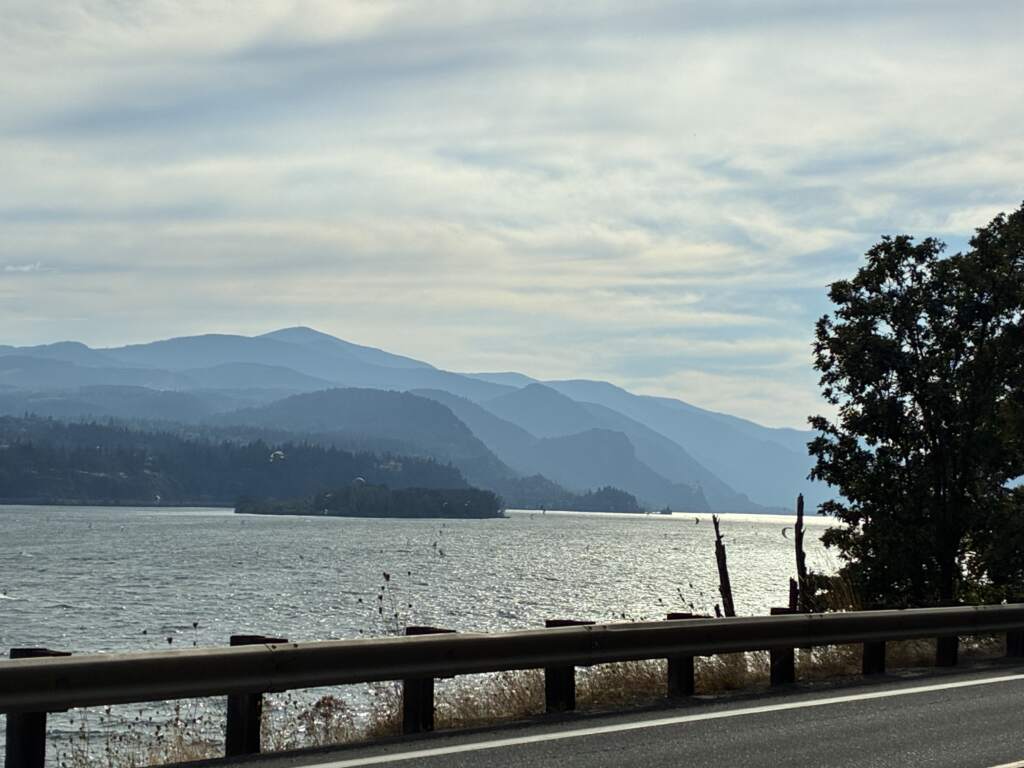
It isn’t. It doesn’t even make the top 10. What it is, though, is the second-deepest lake in the country, right after Crater Lake — which, as it happens, would be our next stop.
And it was while taking this photo of the lake that I pulled over for a few seconds on the roadside. Nati and JP had no room to stop, so they kept going slowly, waiting for me to catch up.
After 13 km, and passing through 5 or 6 tunnels, going faster and faster to close the gap, I got a call from JP asking where I was; I’d missed a turn to the right, and luckily there was GPS coverage in that area, since for most of the trip there wasn’t any.
We found each other again, since I kept falling further and further behind, and at that distance the helmet mesh intercom had already lost the connection between us.
Crater Lake: A Volcano Inside a Volcano
This stop was a last-minute change from JP, who’d heard about the lake and insisted on detouring us there. To me it was a complete unknown. And what an unknown it turned out to be.
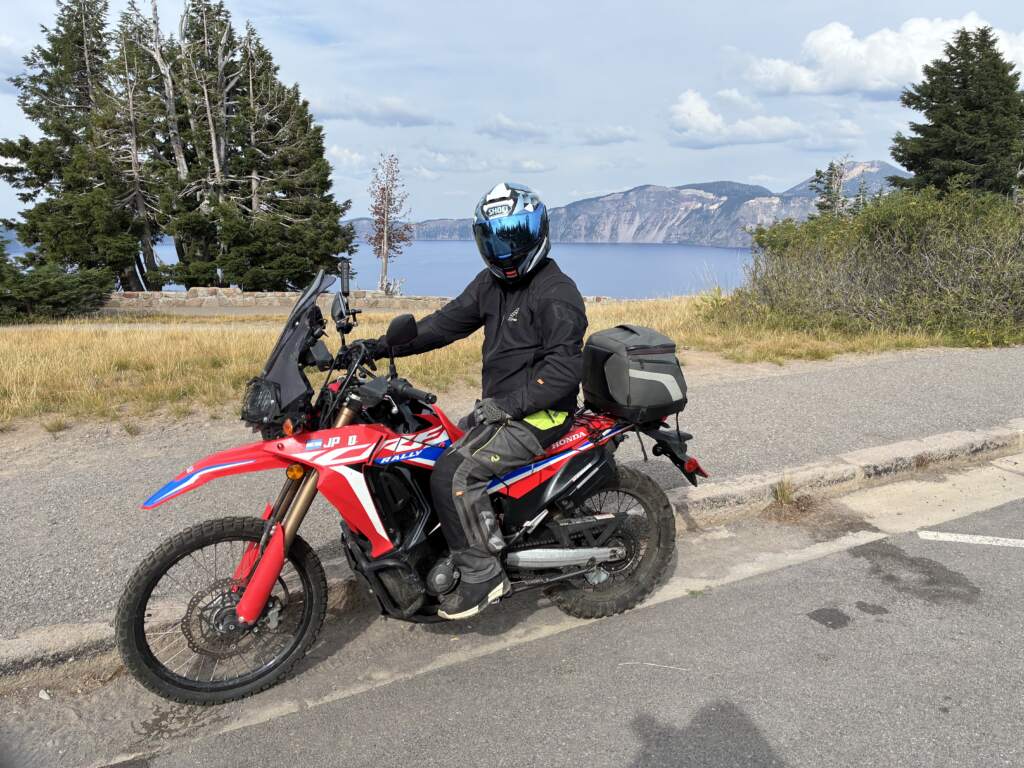
Crater Lake National Park is pure geological magic. A lake born inside a volcano, formed about 7,700 years ago when Mount Mazama collapsed in on itself after a violent eruption, leaving behind a giant caldera that, over the centuries, filled entirely with rainwater and melted snow — with no rivers flowing in or out of it.
That’s why its water has that intense, almost unreal blue, and a clarity that makes it one of the cleanest and deepest lakes in the entire United States — in fact, the deepest in the country.
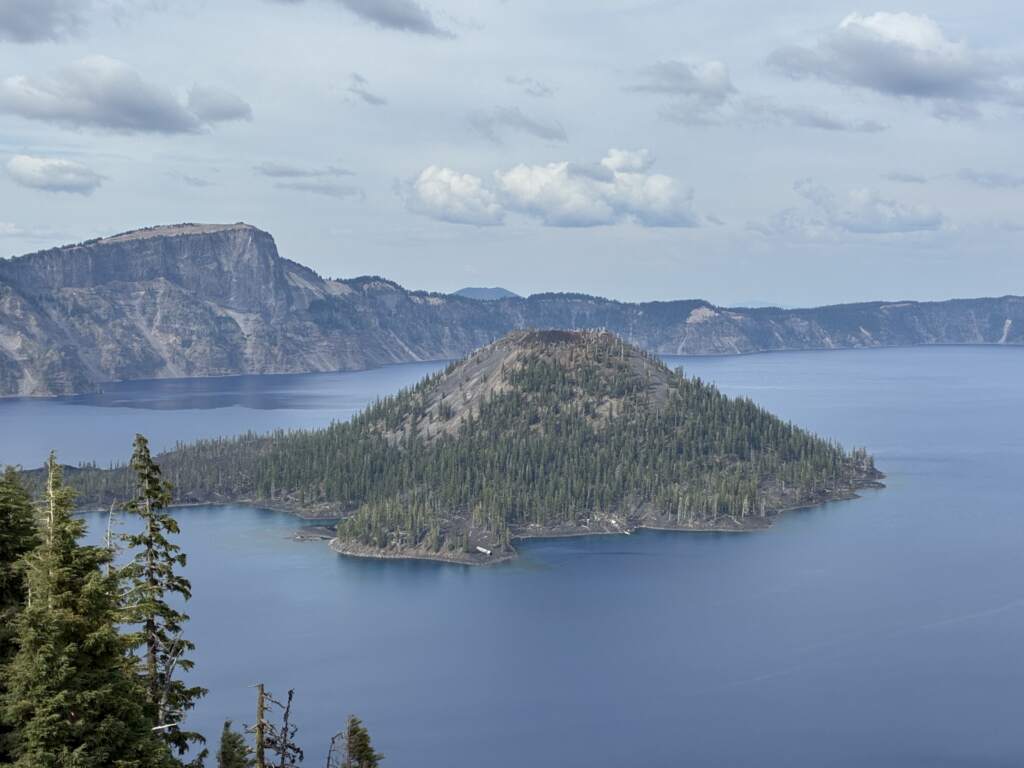
Rising from the middle of the lake is Wizard Island, a small volcanic cone that adds an even stronger sense of another-planet scenery. We stopped at several viewpoints to see it from different angles, and each one looked like a different postcard.
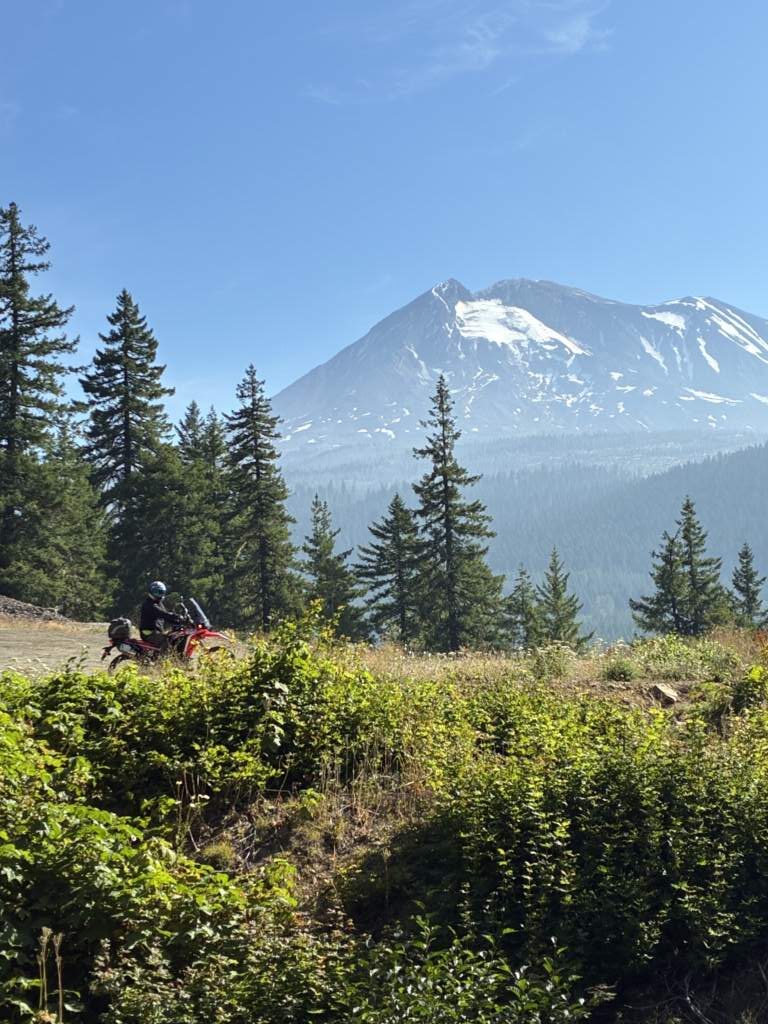
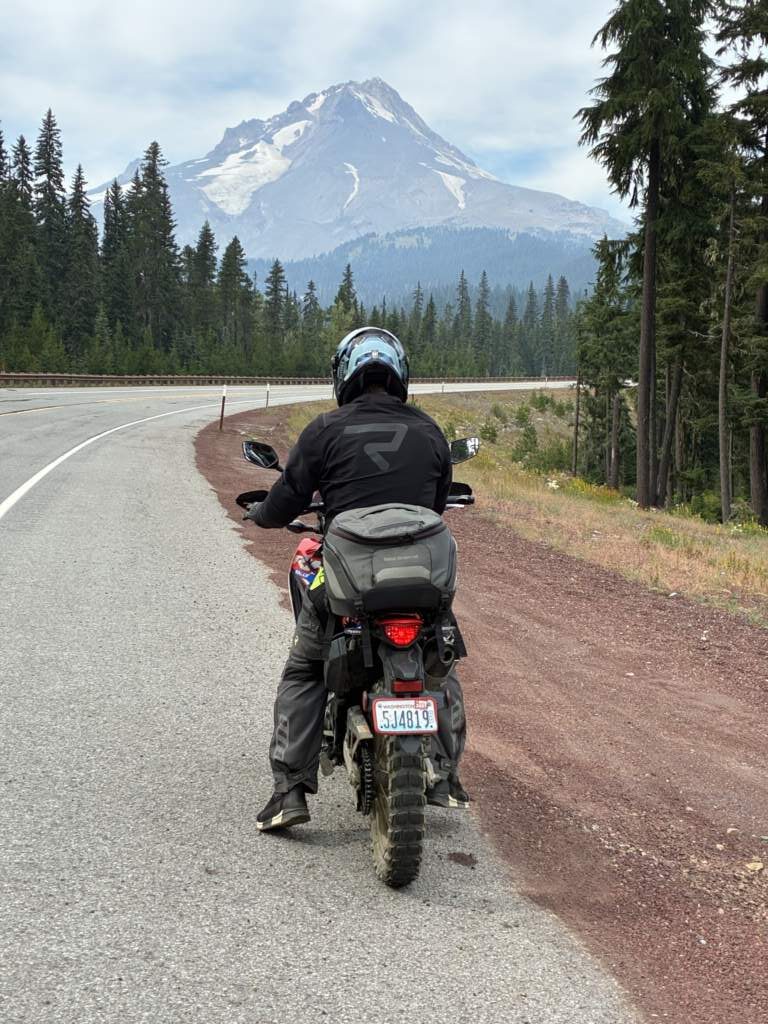
I also won’t forget the moment we rode past Mt Hood, where I took this photo of JP staring at it, completely hypnotized.
The White Salmon Toll Bridge
Before reaching our final day, we passed through White Salmon, a town already in Washington, known for its salmon and for the river running through it — which, of course, shares its name: White Salmon.
Suddenly we found ourselves crossing a toll bridge over the river, about 1,300 meters long.
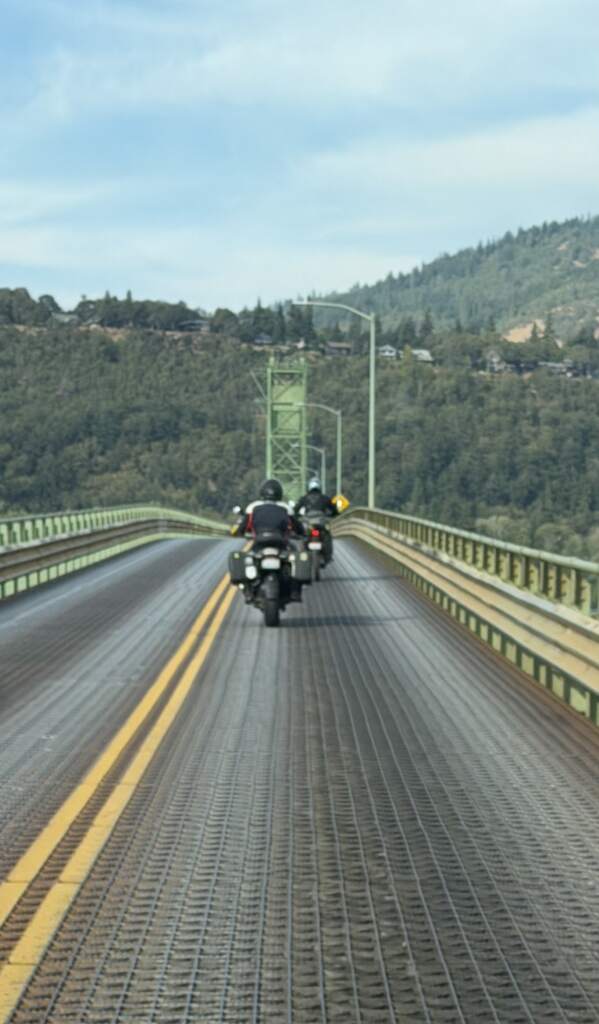
It’s an old and pretty peculiar bridge: it opened to traffic in December 1924, it’s a deck-truss design with a vertical lift span, has extremely narrow lanes — only 2.8 meters wide — and a height restriction of 4.5 meters. Crossing it on a motorcycle, with the truss structure shifting under the wheels from side to side, was quite the experience. And on top of that, paying a toll to ride through lanes the width of a hallway — we still can’t quite understand how it’s still standing given today’s traffic.
Apparently there’s already a project underway to replace it with a new, wider and safer one. When that happens, this one will become a museum piece — well deserved, honestly.
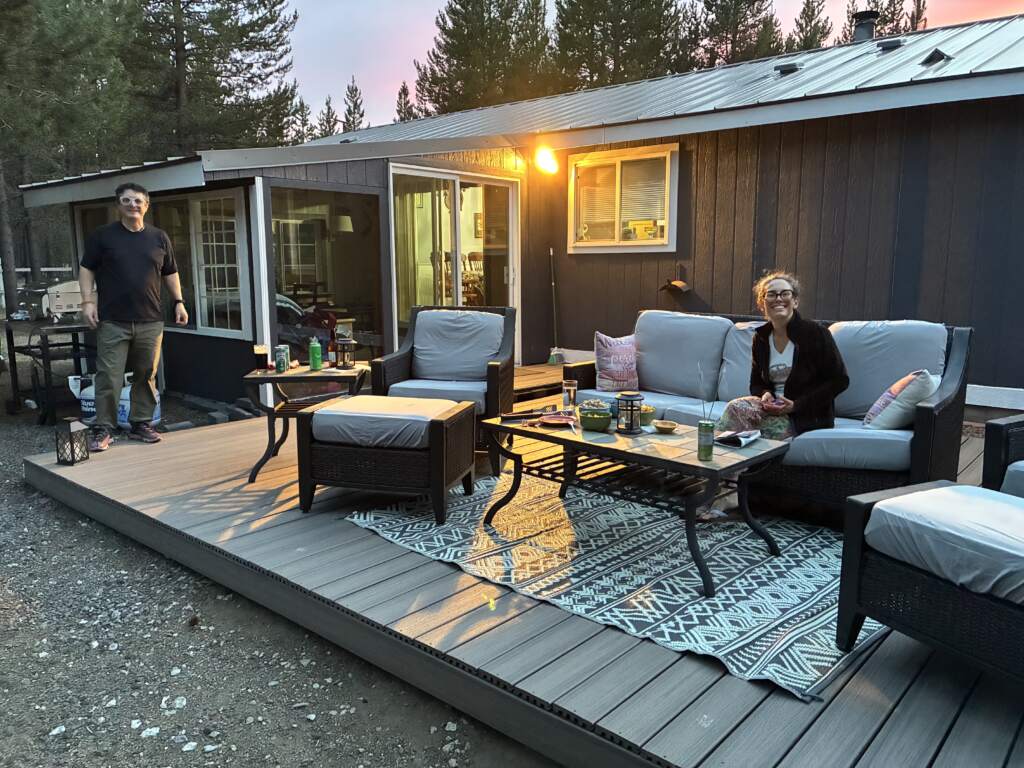
At night we stayed in Airbnbs out in the middle of the forest, ranch-style. Here, grilling out in the middle of nature.
The NF23: The Day JP Turned Offroader
It was the last day of the trip, and we took the route I’d scouted myself back in early 2026. JP, on the fly, changed it at the end to ride into Seattle through Mt Rainier National Park.
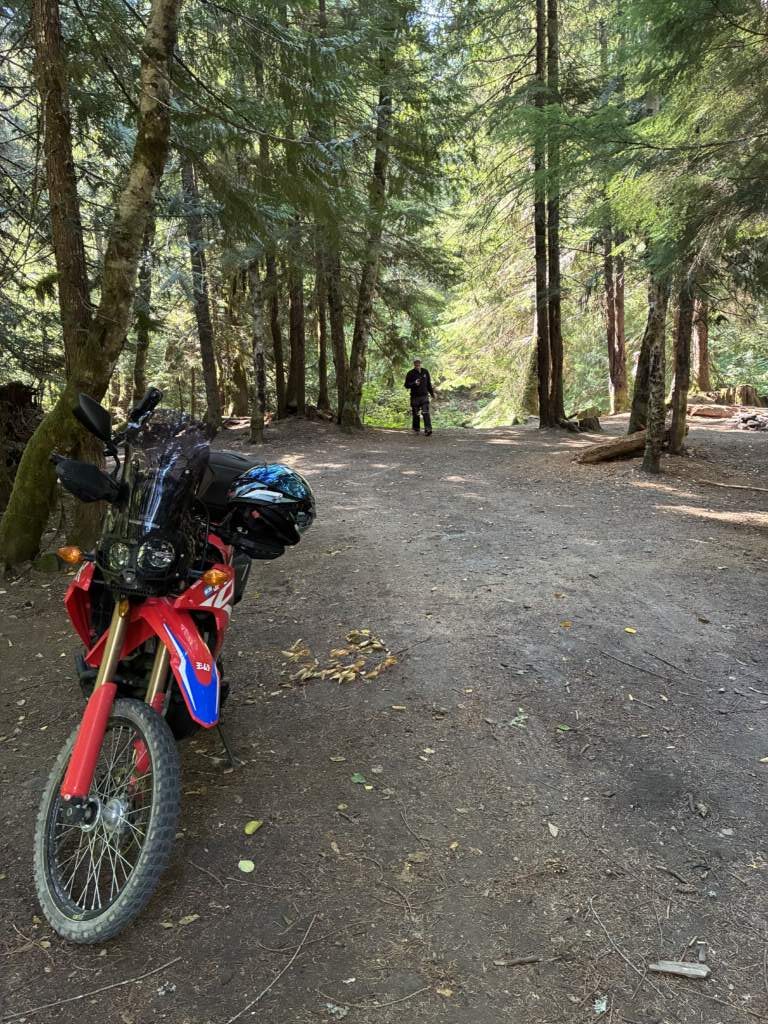
The first 100 km were narrow road, constant curves, through forest so dense it barely let the light through. We were having as much fun as on any stretch of the whole trip. Until JP, riding ahead, spotted a sign: Pavement may vary for the next 11 miles.
Real translation: 11 miles of dirt, no further explanation.
Decision time. Two options: turn around and find another route, guaranteeing over an hour’s delay, or head straight into the dirt without knowing whether it’d be calm gravel or full of “pozos” — the Argentine word for those deep potholes that can throw you off the bike with zero warning.
Being the last day of the trip, and having not dropped the bike once in 11 days, I’d rather have not risked it and arrived in one piece. But offroad calls to JP the way tourist food calls to bears. So he decided to ride his Honda through first, come back for the BMW, and do the stretch twice.
The first two or three miles were riddled with potholes, and you had to watch for a clear line with no real certainty. Nati and I rode behind JP, watching him dodge every pothole like he’d been doing it his whole life. After that, the track improved and became a lot more manageable.
When we went back for the BMW, something unexpected happened: JP was noticeably faster on it than on the Honda 300 Rally. He said he felt more comfortable and barely noticed the bumps. Either way, he got both bikes through, and between one thing and another, the day ran an hour and a half longer than planned.
After that, the NF23 stayed paved, but in pretty rough shape. Over three hours we passed only a handful of cars, every single one with a canoe on the roof — it seemed like an unwritten requirement for driving through there.
The road had potholes everywhere, plus sunken edges marked with white paint — the problem was you only saw them once you were nearly on top of them. JP called out where to ride over the radio. We were in second gear, doing 10 to 15 miles an hour, because going any faster would’ve been suicidal. And that went on for a good while.
The NF23 turned out to be an unforgettable day. We finally stopped at a beautiful spot for, of course, some espressos with the portable coffee maker — the best possible way to close out a day like that.
Mt Rainier: The Giant Watching Over Seattle
We wrapped up the trip by riding into Mt Rainier National Park, which Nati and JP knew well already. We stopped for coffee at their hotel while riding the park road that connects directly to Seattle — another gorgeous stretch of road.
It’s the giant that watches over the city from a distance: an active, though dormant, volcano nearly 4,400 meters tall, dominating the skyline of the entire region and, on clear days, perfectly visible from Seattle itself, more than an hour away.
It’s the highest peak in the entire Cascade Range and the most heavily glaciated in the continental United States — more than 25 glaciers flow down its slopes — which gives it that snow-capped look almost year-round, in contrast with the giant conifer forests and the alpine meadows full of wildflowers in summer, the famous wildflower meadows of Paradise and Sunrise.
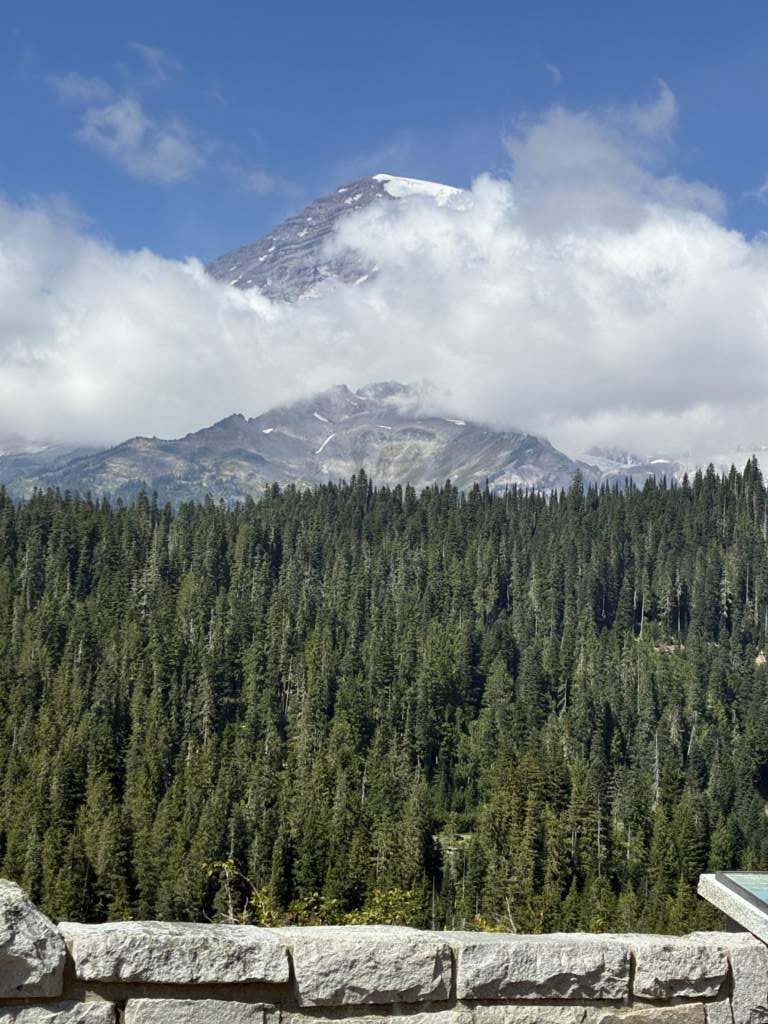
Since it’s an active volcano, the US Geological Survey monitors it closely as one of the most dangerous in the country, precisely because of how close it is to populated areas. That mix of eternal snow, dense forest, and the feeling of standing next to something that “could” wake up at any moment gives Mt Rainier a kind of threatening majesty that stays with you.
What Struck Us Most About the Trip
To wrap up, a few things that really stuck with us:
- The condition of the pavement and roads, noticeably better than in Spain, even on stretches above 3,200 meters of elevation.
- We went in the middle of August, with huge crowds, but everything is so vast that there were barely any lines anywhere — except, oddly enough, for a burger in Yosemite.
- Both in Yosemite and at Mt Rainier we noticed the sheer number of trees knocked down or split by lightning left inside the forest and along the road, with no one clearing them out — a huge potential fuel source in case of fire. Rangers explained they aren’t allowed to remove them, so there they stay.
- How spotlessly clean everything was, with no trash or litter anywhere.
- How different riding a motorcycle feels in Europe versus the United States: there, drivers see you and give you space; here, quite often, they simply don’t see you. You need to ride with extra caution, especially since using turn signals seems optional for a good chunk of drivers.
- And finally, how expensive everything is — hotels, restaurants, gas — even with the dollar having weakened against the euro over the past year.
📍 Resources and recommendations
- Don’t count on finding gas stations in the rural inland areas on the way to Oregon — fill up as soon as you see a pump, even if your tank is still half full.
- Crater Lake National Park is worth the detour even if it wasn’t part of the original plan — some of the most unique scenery of the entire trip.
- If you’re going in summer, the viewpoints around Crater Lake offer very different perspectives from one to the next — it’s worth stopping at more than one.
- Mt Rainier National Park is the perfect stop to close out any route ending near Seattle — the park road itself is worth the detour on its own.
- If you’re up for some light offroad on a big bike, the NF23 (National Forest road) is a memorable experience — go with the right tires and no rush.
Hotels from the trip (personal rating, out of 10):
- Garibaldi — The Hotel Garibaldi: 6/10
- Gold Beach — Jot’s Resort: 6/10
- Fort Bragg — Holiday Inn Express Fort Bragg: 2/10
- Santa Cruz — The Inn at Pasatiempo: 8/10
- Visalia — Wyndham Visalia: 7/10
- Mariposa — Best Western Plus Yosemite: 7/10
- Lee Vining — Lake View Lodge: 7/10
- Westwood — Airbnb: 8/10
- Crescent — Airbnb: 9/10
- White Salmon — Airbnb: 9/10
Seattle to Yosemite Motorcycle Trip — Full Series
- Seattle to Yosemite: Planning an 11-Day Motorcycle Trip
- Highway 1: From Astoria to the Redwoods
- San Francisco to Big Sur Motorcycle Trip: Golden Gate, the Gremlin Myth, and a Wildfire Closure
- Sequoia National Park Motorcycle Trip: Heat & Gas
- Yosemite National Park Motorcycle Trip: El Capitan & Half Dome
- Crater Lake, Lake Tahoe, and the NF23: The Last Days of the Ride