
The Sequoia National Park motorcycle trip stretch began right after we accepted the inland detour caused by the Big Sur wildfire. It was time to turn east for good, leave the coast behind, and head for Visalia, the town that serves as the gateway to Sequoia National Park and its giant sequoias. And that’s where another chapter of the trip began, very different from the days before.
Unbearable Heat
Over that roughly 5-hour ride, we went from 13-14°C on the coast to 40°C with no transition at all — and that heat stayed with us all the way to Visalia. There was no escaping it.
The strange part is that the logic works backwards from what you’d expect. Normally, it’s colder in the mountains than on the coast. On the Pacific it’s the exact opposite: heat at elevation, cool by the coast. It’s hard to get used to.
Riding at 37-40°C for two or three hours straight isn’t something I’d recommend to anyone. Nati carried electrolytes in the car, and we stopped every 45 minutes to drink water like there was no tomorrow — because even when your body doesn’t always signal it with the urgency it should, you have to force it. We stayed disciplined, and it paid off.
RVs the Size of a House
One of the most impressive things about American roads is the RVs. Some expand out on all sides, gaining extra square meters of bedroom space at the push of a button. Others were torpedo-shaped, rounded, with a gorgeous retro look.
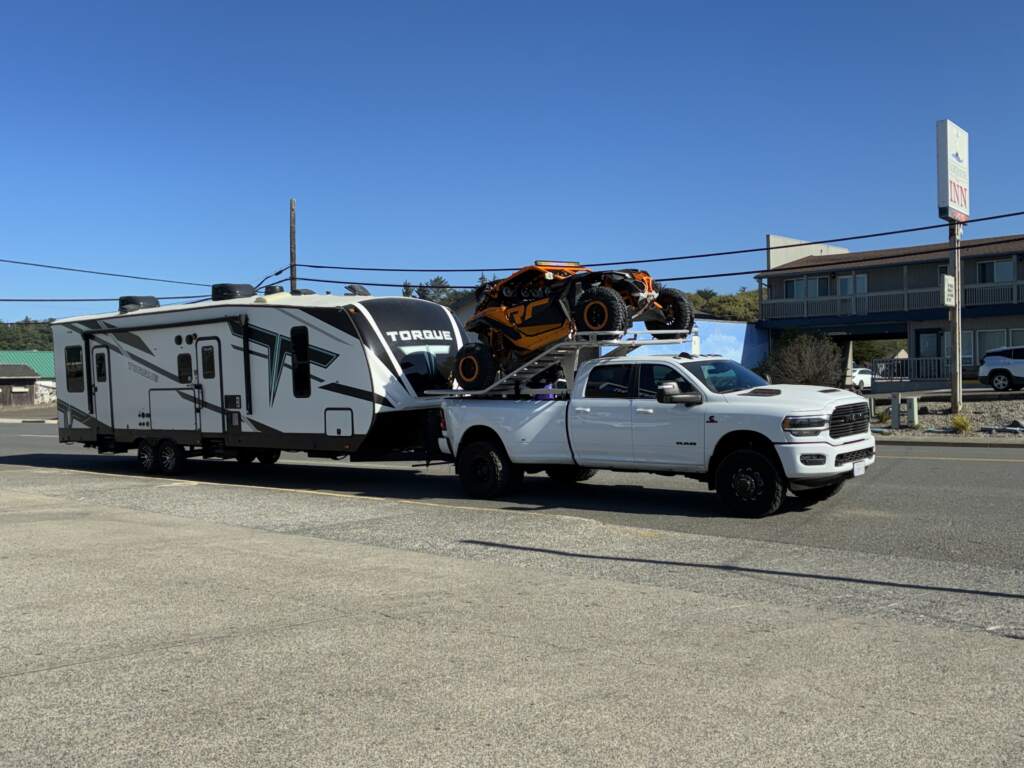
But the hardest thing to believe, without a doubt, were the massive buses hauling an entire Jeep Wrangler behind them. You have to see it to believe it — a bus towing a car the way you’d tow a bicycle.
Gas: Expensive, Scarce, and a Game of Nerves
We did the math on 92-octane gas, the kind we filled the bikes with. Over the last 5 years it had gone up 60% in the United States and 40% in Europe. A liter of 92-octane was going for $1.4 — outrageous by American standards.
The BMW had better range than the Honda, and there’s a photo of JP celebrating like he’d just won a race, after rolling into a gas station with a single pump on 0 km of range. It was the closest we came to actually getting stranded — more than 100 km without a single place to refuel.
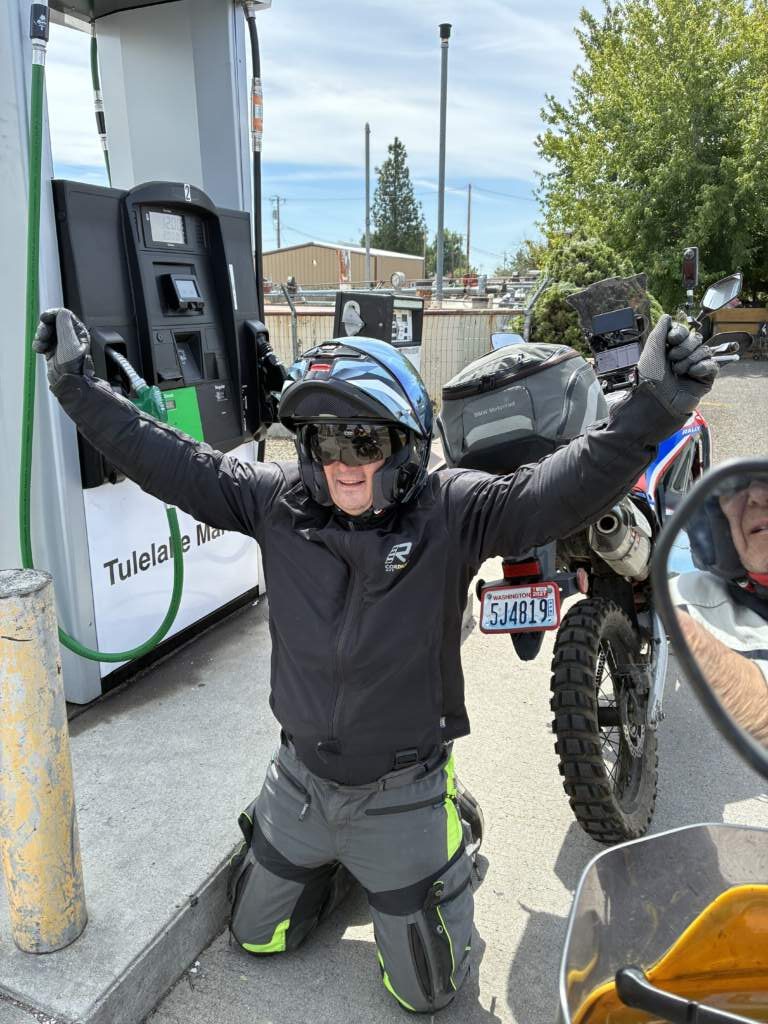
While JP breathed easy with a full tank, I went in to pay and ended up chatting with the clerk, a man of Indian origin.
“Where are you from?” he asked me.
“Spanish,” I said. “And you – Indian-American, or American of Indian descent?”
“Indian-American. But I go back to India every year, to see family.”
I told him I was actually planning to go there myself this year – to Assam, a state in the north of India, next to Bangladesh, bordering Bhutan. A motorcycle trip through that whole area brushing up against China and Bhutan.
His face completely changed.
“Come on, why would you go there? That’s very dangerous. Are you sure?”
“Yeah, yeah,” I said, laughing. “I’ve been following a female rider who’s done the route, the photos are incredible, at three or four thousand meters. We’re going in December.”
“In December? Why would you even think of that? And on top of it you have to keep looking over your shoulder the whole time, it’s not safe at all.”
I asked him if he’d ever been there himself.
“No. Never been, and never will. I wouldn’t let anyone in my family go either. It’s not a safe place.”
Eventually he relaxed a bit and admitted that if we were going as a group, all the better – but to be very careful. I kept smiling for the rest of the day: the classic case of someone who’s never been somewhere but is absolutely certain how dangerous it is.
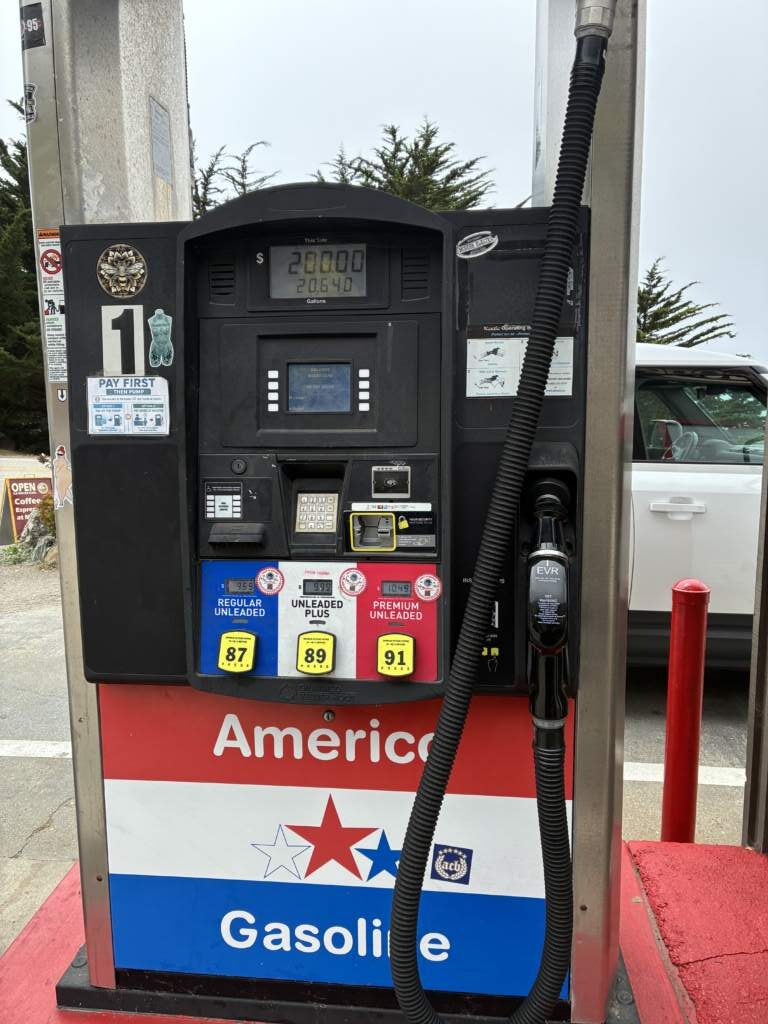
Oh, and we also came across pumps at wildly inflated prices, like this one at $10.41 a gallon for 91-octane, versus the $5.5-6 a gallon that was the reference point for the trip; when we pulled in to fill up and saw the price, we just kept going: free market, if you want it you pay for it, and if not you leave it — and we left it.
Continuing on, after that gas-station lifesaver, a question came up that would stay with us for the rest of the trip: what do the ranches in these isolated areas actually do? Do they keep their own reserve tanks? Because the distance to the nearest gas station is considerable, and it doesn’t seem like a small problem.
Harley, Harley, and More Harley
We were swimming against the current, because in the United States the reigning motorcycle, by far, is the Harley-Davidson. We crossed paths with two different groups at the same hotel.
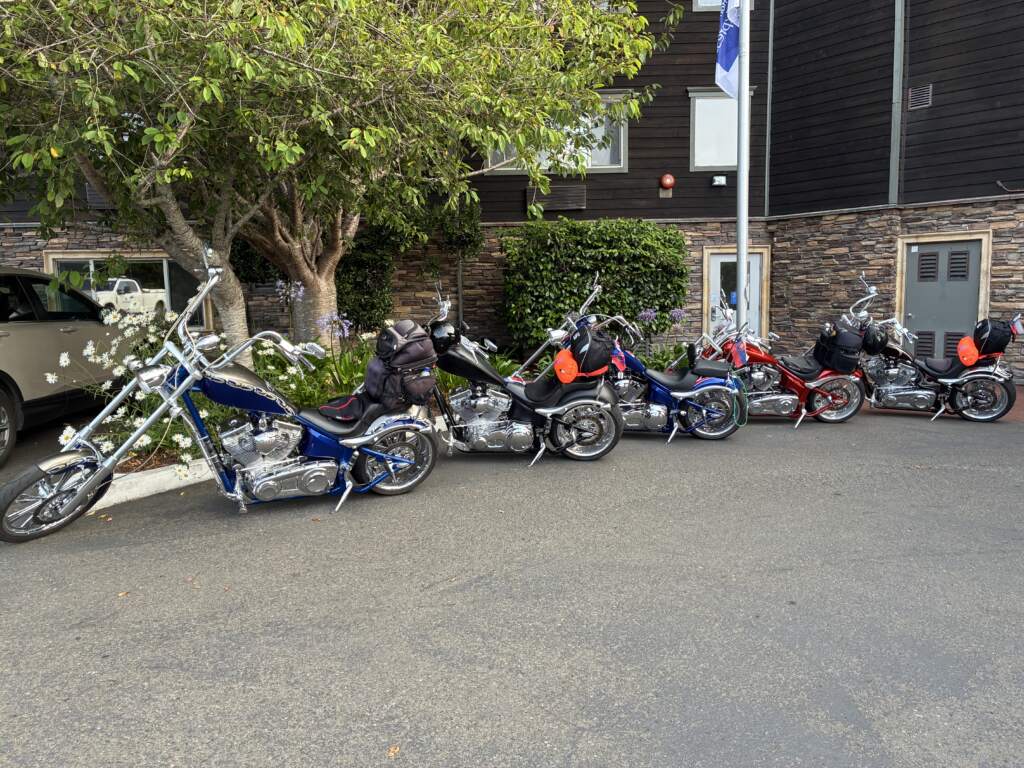
One group traveled with a support car, mechanic, driver, and a truck for luggage — the chopper crowd, all matching, all in coordinated colors. I sat on one just to try it, and the riding position can only be described as “strange”: you sit practically on the ground, arms fully stretched out to the handlebars.
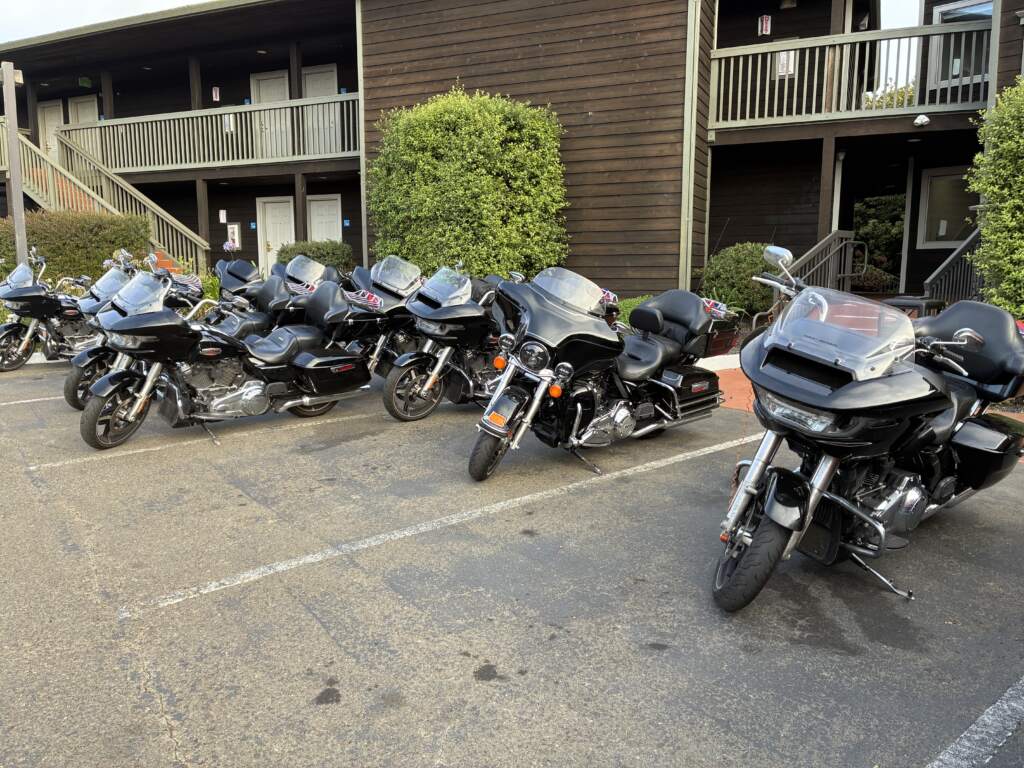
The other group rode independently, also on Harleys but the touring kind, very well equipped. To each their own bike and their own style — what matters, in the end, is enjoying two wheels, whatever the brand. That said, we barely saw any BMWs, and even fewer Ducatis. We were the exception almost the entire trip.
The General Sherman Tree
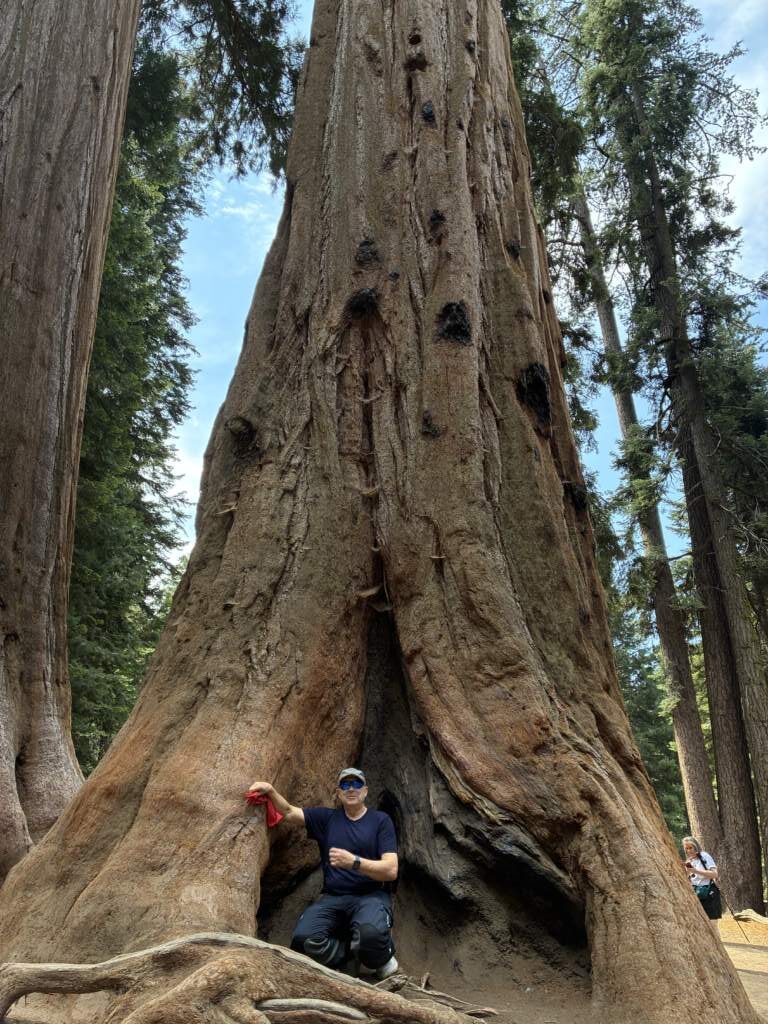
After a night in Visalia, the 40°C heat still clinging to our skin, we reached the giant sequoia park. We parked the bikes and walked over to see what’s said to be the largest tree in the world — save for one or two others whose exact location isn’t known — the legendary General Sherman.
You really need to stand next to one to grasp the scale of these trees. No photo without a human for reference does it justice.
Did you know sequoia cones are sealed with resin and need fire to open and release their seeds? Without flames, a cone can stay shut on the tree for years, and without that opening there’s no forest regeneration. Understanding this has changed how the park is managed: controlled burns are now started on purpose, to keep the reproduction cycle of these giants alive.
📍 Resources and recommendations
- If you’re crossing from the Pacific coast inland in summer, brace for a brutal temperature jump — carry water and electrolytes, and stop every 40-45 minutes even if you’re not thirsty.
- Sequoia National Park and the General Sherman Tree are a little over an hour from Visalia — a must-stop if you’re heading toward Yosemite.
- Fill up whenever you can in this area; gas stations are scarce and prices vary wildly from one town to the next.
Seattle to Yosemite Motorcycle Trip — Full Series
- Seattle to Yosemite: Planning an 11-Day Motorcycle Trip
- Highway 1: From Astoria to the Redwoods
- San Francisco to Big Sur Motorcycle Trip: Golden Gate, the Gremlin Myth, and a Wildfire Closure
- Sequoia National Park Motorcycle Trip: Heat & Gas
- Yosemite National Park Motorcycle Trip: El Capitan & Half Dome
- Crater Lake, Lake Tahoe, and the NF23: The Last Days of the Ride